Media: exhibition
I design things to support my work and others: exhibitions, architecture, furniture, hardware, and graphics. Making is a form of study—combining traditional techniques with new technologies to find low-cost, DIY methods that yield surprising qualities. I like artifacts that straddle boundaries: virtual/physical, analogue/digital, traditional/progressive.
About
I design things to support my work and others: exhibitions, architecture, furniture, hardware, and graphics. Making is a form of study—combining traditional techniques with new technologies to find low-cost, DIY methods that yield surprising qualities. I like artifacts that straddle boundaries: virtual/physical, analogue/digital, traditional/progressive.
Quantum Itineraries Live Visuals
A suite of tools and visualizations in Unity for live-generated 3D visuals projected behind performers at 8K for dome or classical displays, using procedurally generated meshes and shaders. I built the system for the Quantum Itineraries music performances, a festival featuring quantum computer music where quantum simulations are core to composition and instrumentation. The quantum simulation data that generated the music also drove the visuals directly, with WebRTC routing Unity's output to a mixer for the projection.
CryoLumens
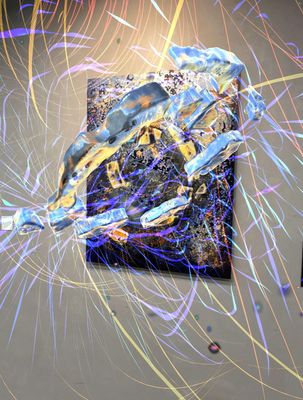
An AR artwork representing the strength and location of Earth's magnetic fields using NASA's real-time sensor network, overlaying data-driven particle systems on an original painting using image tracking. When viewed through a phone, the painting comes alive with particles that shift and flow based on live magnetic field data. I developed the coding and visuals for Eli Joteva.Technical: Live sensor intensities are baked into packed textures so particles animate by interpolating a texture index on the GPU, keeping the visualization real-time without CPU overhead.
Guccibytes
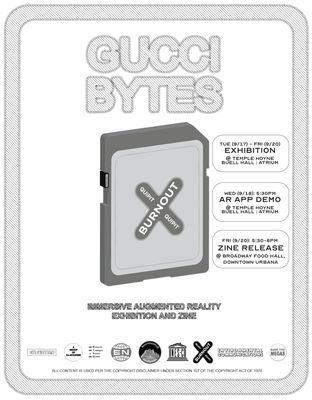
An exhibition and print zine showcasing unfinished speculative pieces from our studio organization, Quipit, with a focus on revealing the often-unseen digital components of our work. The zine was printed on long scrolls wrapped around PVC lattices, with embedded QR codes linking to AR content in Wikar. Each contributor used the platform differently: some created virtual galleries, others showed complex models on virtual plinths, and I created a "3D portal" to show one of my miniature models staged in its fictional setting. The physical exhibition components were built from materials recycled from a previous project.
Timeline Atlas
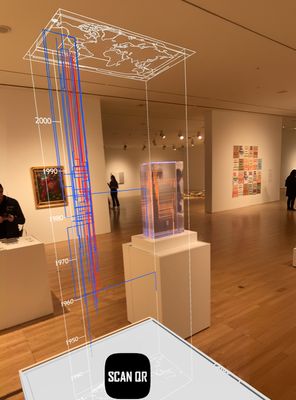
Two AR data-visualization sculptures visualizing datasets too complex to depict through physical sculpture: the home locations of all female senators over the past century. I collaborated with artist Stephen Cartwright, known for meticulously logging personal data over decades and crafting it into acrylic sculptures that exhibit spatial-temporal patterns. We used AR to go beyond his traditional manufacturing techniques. Debuted as part of a faculty showcase in 2019.