
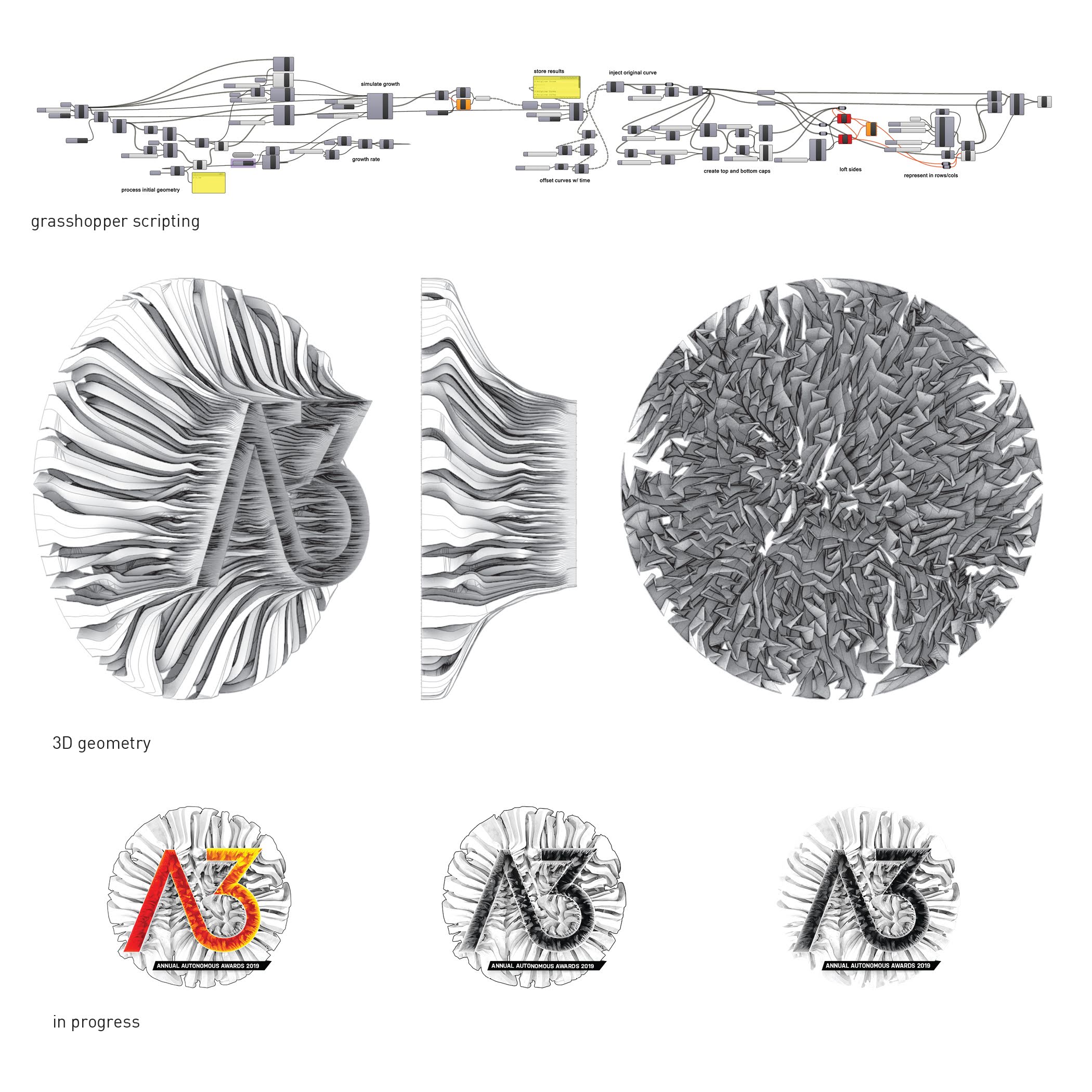
A3 Award Logo
A logo generated using a reaction-diffusion physics simulation in Grasshopper, configured to store the entire time-series of the simulation. By extruding this data with the Z-axis representing time, the final form visualizes the 'A3' letters growing to fill the constraints of the badge shape, creating an intricate pattern where the content is determined by the constraints of its graphic container. My entry to the A3 (Annual Architecture Awards) logo competition.
Related Projects
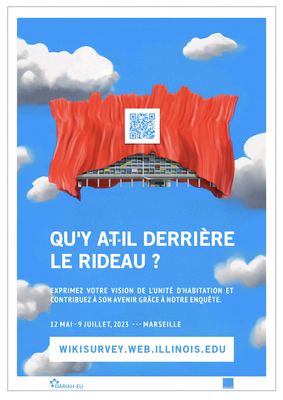
Unité d'Habitation Poster
A poster with basic information, a QR code, and URL using a simple visual element to imply mystery. We designed this to draw exhibition visitors to our wiki survey on public perceptions of Le Corbusier's Unité d'Habitation.
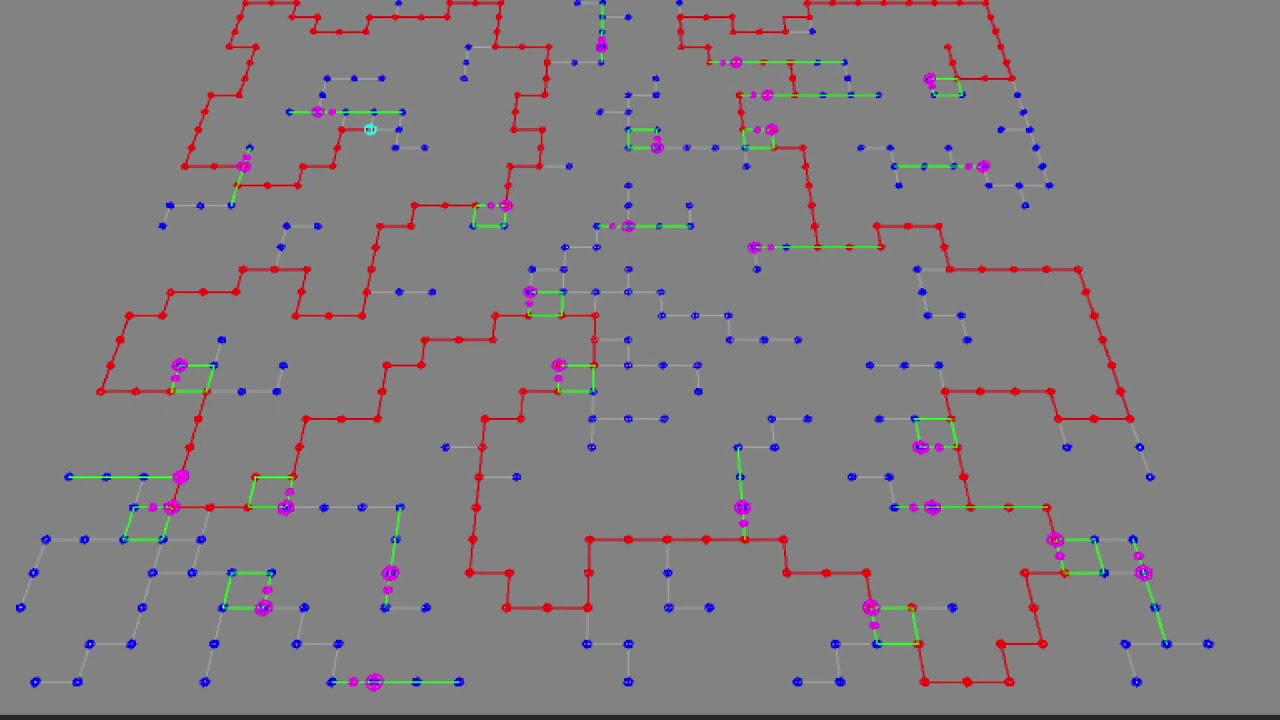
Puzzle Generation
A dungeon generator where monsters trawl on fixed and cyclical paths, creating a looping temporal structure where an agent attempts to reach the end in the shortest amount of forward steps. I developed this using Dijkstra's shortest path algorithm to solve for a sequence of moves in time rather than a shortest traversal path in space, as a final project for a course in algorithmic design.
Drip
A dreamlike ball platformer created in one week for the C.H.A.I.N. collaboration. My task was to create a sequel to a first-person hospital game. To meet the deadline, I used Grasshopper for procedural level design, creating a large, open dreamscape where the player floats downwards. This parametric approach allowed me to efficiently place collectibles, asteroids, and hazardous tentacles along splines with random variation, directing the player's movement through the space.
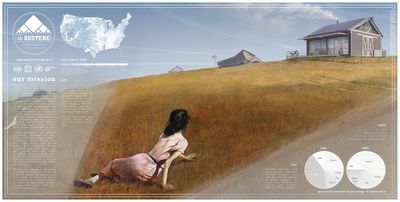
The Austere
CRITICAL MASS Student Choice Award, 2018A speculative project that imagines a near-future of climate catastrophe where corporations provide prefabricated housing tied to labor contracts. Originally a design-build proposal for the U.S. Solar Decathlon, I reformulated the work to explore how speculative design could feel more imminent and unsettling. Instead of distant hyperbole, the project grounded its extreme scenario in plausible economic and social trends, positioning it between architectural proposal, narrative fiction, and propaganda artifact. Exhibited as a large-format presentation board and later as an augmented reality installation, the work won the Student Choice Award at Critical Mass in 2018.