Puzzle Generation
A dungeon generator ↗ where monsters trawl on fixed and cyclical paths, creating a looping temporal structure where an agent attempts to reach the end in the shortest amount of forward steps. I developed this using Dijkstra's shortest path algorithm to solve for a sequence of moves in time rather than a shortest traversal path in space, as a final project for a course in algorithmic design.
Related Projects

A3 Award Logo
A logo generated using a reaction-diffusion physics simulation in Grasshopper, configured to store the entire time-series of the simulation. By extruding this data with the Z-axis representing time, the final form visualizes the 'A3' letters growing to fill the constraints of the badge shape, creating an intricate pattern where the content is determined by the constraints of its graphic container. My entry to the A3 (Annual Architecture Awards) logo competition.
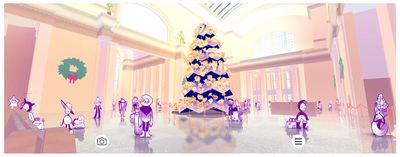
Where's Home?
An experimental game prototype conceived as the next evolution of the People's Tree series. Where previous iterations had players designing ornaments for a shared space, this version reimagined the format around NPCs: players meet characters throughout an abstracted version of Union Station in Chicago, ask them questions, and contribute answers that populate other players' encounters—so the station gradually fills with player-authored characters to discover. The game translated the unshaded, minimalist aesthetic of Rococo into a more detailed architectural style. For the prototype, I developed a custom Rhinoceros plugin to export modular architectural elements, and a separate system to place around 100 unique characters throughout the scene. The project was shelved to allow for more design iteration on its dialogue system.
C.H.A.I.N.G.E.D.
A large-scale, collaborative follow-up to C.H.A.I.N., this project connects over 40 developers' games into a branching narrative. After each entry, the player chooses between two games, representing forks in the timeline. My primary contribution was designing the technical architecture that enabled this branching to occur within the launcher itself, rather than individual games. This key decision made the project feasible to implement across multiple engines and contributors. You can play the full collection here and read an interview about the project.
Drip
A dreamlike ball platformer created in one week for the C.H.A.I.N. collaboration. My task was to create a sequel to a first-person hospital game. To meet the deadline, I used Grasshopper for procedural level design, creating a large, open dreamscape where the player floats downwards. This parametric approach allowed me to efficiently place collectibles, asteroids, and hazardous tentacles along splines with random variation, directing the player's movement through the space.