Games: collaboration
I ship software people play: video games, apps, and creative infrastructure. I’ve built mixed reality systems for real world exhibitions, cultural heritage, scientific research, and design previsualization. I care about the layers beneath the surface of interactive software—editor tooling, technical art, and performance—and how to design systems that learn from the people who use them.
About
I ship software people play: video games, apps, and creative infrastructure. I’ve built mixed reality systems for real world exhibitions, cultural heritage, scientific research, and design previsualization.
I care about the layers beneath the surface of interactive software—editor tooling, technical art, and performance—and how to design systems that learn from the people who use them.
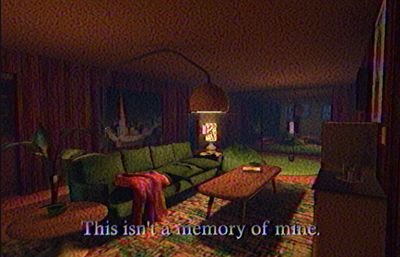
BACKBONE
An immersive horror, first-person stealth exploration game spanning approximately 30 minutes, rendered with NTSC analogue-style graphics that mimic the rainbow iridescence of 1970s television. BACKBONE is my contribution to C.H.A.I.N. 3, a collaborative network where each developer builds a game world connected to others through doors. Continuing directly from the network's starting game, it expanded the exposition and connected to three other games. The game recreates an early 70s midwestern basement—a childhood memory of one of the lead characters—using modular architectural assets to build an atmospheric period environment. Technical features include an inspection system for environmental storytelling, a phone call system for delivering dialogue sequences, and stealth gameplay with enemy AI that uses a finite state machine and procedural, physics-based animation. Within the network, BACKBONE bridges multiple narrative threads and establishes mechanical systems used by subsequent developers.
C.H.A.I.N. 3
The third entry in the C.H.A.I.N. experimental series, this project is a spatially distributed network of game worlds, each built by its own developer, bringing together over 120 contributors from the Haunted PS1 collective and the wider indie community. A door in one game leads to a door in another, and the player's save state is shared between them. As co-director and lead technical developer, I built the launcher application that coordinates these transitions and ensures uniformity across the network. Because the scale is larger than any single person can engage with, the launcher also managed distributed QA via a real-time analytics dashboard, using player movement data to surface errors and bugs across the network. This was supported by a custom automated build system for syncing developer builds, along with other purpose-built coordination tools for over 100 simultaneous contributors.
SOUP ROOMS: Sodium
An atmospheric exploration room created for SOUP ROOMS (2025), a virtual gallery system directed by Akuma Kira & Kite Line. SOUP is a rigid creative format lifted from a 2007 artware game; its many subsequent releases now exhibit 300+ rooms, suggesting how set technical constraints can scale participation and reward ingenuity. Contributors define their cube-shaped "rooms" from a fixed set of images and sounds. SOUP-making has been used as a charrette exercise in game design studios, where it can teach the fundamentals of game assets, collaborative work, and creative economy. My contribution, Sodium, places the player in a sodium-lit parking lot on a midsummer night, pairing a soundscape of cicadas and a distant storm with spherical projection mapping to evoke warm light and deep shadow.
The People's Sky 2
The fifth iteration of the People's Tree series—where players design items and place them in a shared digital space—developed as the centerpiece for the 2025 Madvent launcher. I was invited by the junior team—who had taken over the launcher technology and coordination—to contribute this game for continuity with the series. My contributions focused on technical refinement: redesigning and optimizing the input system for better panning and zooming, recoloring and reskinning the visual aesthetic, and optimizing data serialization and loading sequences. The project marks my transition from lead developer to technical consultant as the junior team took over coordination.
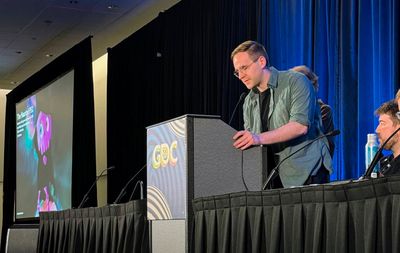
Experimental Games Workshop
A presentation at the Experimental Games Workshop (EGW), held during the Game Developers Conference (GDC) in San Francisco. With co-presenter Adam Pype, I discussed our project C.H.A.I.N.G.E.D. and the collaborative work of the Haunted PlayStation 1 collective. The EGW is a GDC tradition of over 20 years that showcases games at the forefront of gameplay, organization, and creative direction. A full video is available in the GDC Vault, linked above.
C.H.A.I.N.G.E.D.
A large-scale, collaborative follow-up to C.H.A.I.N., this project connects over 40 developers' games into a branching narrative. After each entry, the player chooses between two games, representing forks in the timeline. My primary contribution was designing the technical architecture that enabled this branching to occur within the launcher itself, rather than individual games. This key decision made the project feasible to implement across multiple engines and contributors. You can play the full collection here and read an interview about the project.
Genesis
A light-gun game inspired by vector graphics that reimagines the credit crawl sequence from Super Smash Bros. Melee (2001). I developed this game as my submission for the C.H.A.I.N.G.E.D. collaboration. The project was an opportunity to explore motion-captured camera work, gameplay-to-music synchronization, a blocking system for sequencing events, and vector-based rendering.
Drip
A dreamlike ball platformer created in one week for the C.H.A.I.N. collaboration. My task was to create a sequel to a first-person hospital game. To meet the deadline, I used Grasshopper for procedural level design, creating a large, open dreamscape where the player floats downwards. This parametric approach allowed me to efficiently place collectibles, asteroids, and hazardous tentacles along splines with random variation, directing the player's movement through the space.
C.H.A.I.N.
An early collaboration by the Haunted PS1 collective, C.H.A.I.N. was an experimental game series with a unique structure: each developer received a game, created a direct sequel, and then passed it to the next person in the chain. I participated in this project, contributing my own entry, "Drip." The unpredictable, flowing narrative worked well, and the experiment's popularity directly led to the creation of a more ambitious sequel, C.H.A.I.N.G.E.D., in 2022.