Games: game
I ship software people play: video games, apps, and creative infrastructure. I’ve built mixed reality systems for real world exhibitions, cultural heritage, scientific research, and design previsualization. I care about the layers beneath the surface of interactive software—editor tooling, technical art, and performance—and how to design systems that learn from the people who use them.
About
I ship software people play: video games, apps, and creative infrastructure. I’ve built mixed reality systems for real world exhibitions, cultural heritage, scientific research, and design previsualization.
I care about the layers beneath the surface of interactive software—editor tooling, technical art, and performance—and how to design systems that learn from the people who use them.
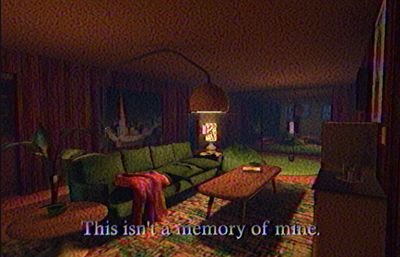
BACKBONE
An immersive horror, first-person stealth exploration game spanning approximately 30 minutes, rendered with NTSC analogue-style graphics that mimic the rainbow iridescence of 1970s television. BACKBONE is my contribution to C.H.A.I.N. 3, a collaborative network where each developer builds a game world connected to others through doors. Continuing directly from the network's starting game, it expanded the exposition and connected to three other games. The game recreates an early 70s midwestern basement—a childhood memory of one of the lead characters—using modular architectural assets to build an atmospheric period environment. Technical features include an inspection system for environmental storytelling, a phone call system for delivering dialogue sequences, and stealth gameplay with enemy AI that uses a finite state machine and procedural, physics-based animation. Within the network, BACKBONE bridges multiple narrative threads and establishes mechanical systems used by subsequent developers.
C.H.A.I.N. 3
The third entry in the C.H.A.I.N. experimental series, this project is a spatially distributed network of game worlds, each built by its own developer, bringing together over 120 contributors from the Haunted PS1 collective and the wider indie community. A door in one game leads to a door in another, and the player's save state is shared between them. As co-director and lead technical developer, I built the launcher application that coordinates these transitions and ensures uniformity across the network. Because the scale is larger than any single person can engage with, the launcher also managed distributed QA via a real-time analytics dashboard, using player movement data to surface errors and bugs across the network. This was supported by a custom automated build system for syncing developer builds, along with other purpose-built coordination tools for over 100 simultaneous contributors.
SOUP ROOMS: Sodium
An atmospheric exploration room created for SOUP ROOMS (2025), a virtual gallery system directed by Akuma Kira & Kite Line. SOUP is a rigid creative format lifted from a 2007 artware game; its many subsequent releases now exhibit 300+ rooms, suggesting how set technical constraints can scale participation and reward ingenuity. Contributors define their cube-shaped "rooms" from a fixed set of images and sounds. SOUP-making has been used as a charrette exercise in game design studios, where it can teach the fundamentals of game assets, collaborative work, and creative economy. My contribution, Sodium, places the player in a sodium-lit parking lot on a midsummer night, pairing a soundscape of cicadas and a distant storm with spherical projection mapping to evoke warm light and deep shadow.
The People's Sky 2
The fifth iteration of the People's Tree series—where players design items and place them in a shared digital space—developed as the centerpiece for the 2025 Madvent launcher. I was invited by the junior team—who had taken over the launcher technology and coordination—to contribute this game for continuity with the series. My contributions focused on technical refinement: redesigning and optimizing the input system for better panning and zooming, recoloring and reskinning the visual aesthetic, and optimizing data serialization and loading sequences. The project marks my transition from lead developer to technical consultant as the junior team took over coordination.
GENESIS 2K24
A head-tracked rhythmic rail-shooter that traces the cyberspace aesthetics of Rez (2001) back to their origins in Chicago's art and technology scenes. In collaboration with Charles Voita and Bill Derrah, I led development on this remake of my 2023 C.H.A.I.N.G.E.D. entry. The game reimagines the Electronic Visualization Laboratory's (EVL) 3D vector graphics for Star Wars (1977) and incorporates head-tracking from the CAVE system (1992), set to Phuture's genre-defining Acid Tracks (1985). It was exhibited at the BitBash 2024 festival.
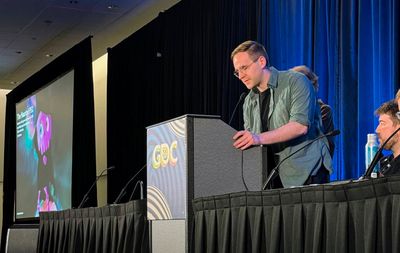
Experimental Games Workshop
A presentation at the Experimental Games Workshop (EGW), held during the Game Developers Conference (GDC) in San Francisco. With co-presenter Adam Pype, I discussed our project C.H.A.I.N.G.E.D. and the collaborative work of the Haunted PlayStation 1 collective. The EGW is a GDC tradition of over 20 years that showcases games at the forefront of gameplay, organization, and creative direction. A full video is available in the GDC Vault, linked above.
C.H.A.I.N.G.E.D.
A large-scale, collaborative follow-up to C.H.A.I.N., this project connects over 40 developers' games into a branching narrative. After each entry, the player chooses between two games, representing forks in the timeline. My primary contribution was designing the technical architecture that enabled this branching to occur within the launcher itself, rather than individual games. This key decision made the project feasible to implement across multiple engines and contributors. You can play the full collection here and read an interview about the project.
Genesis
A light-gun game inspired by vector graphics that reimagines the credit crawl sequence from Super Smash Bros. Melee (2001). I developed this game as my submission for the C.H.A.I.N.G.E.D. collaboration. The project was an opportunity to explore motion-captured camera work, gameplay-to-music synchronization, a blocking system for sequencing events, and vector-based rendering.
Madvent 4: End of the Line
The launcher for the 2023 Madvent event, an annual Haunted PS1 collaboration where ~30 creators release games daily throughout December. With co-developer Vladimere Lhore, I created a fully dynamic train that journeys through various biomes and navigates twisting terrain to connect the individual games.
The People's Sky
The fourth iteration of the People's Tree series, The People's Sky is an experimental game where players design items, append messages, and place them in a shared digital sky. A key design change was constraining the color palette to reduce the visual cacophony of earlier iterations. I also developed data-transfer optimizations, analytic logs for post-experiment analysis, a web application for content moderation, and 'trace' visualizations that passively record and display player exploration paths.
Haunted PS1 Demo Disc: Spectral Mall
A first-person horror game set in an abandoned mall, built as the launcher for the 2022 Haunted PS1 Demo Disc—a curated collection of games selected from hundreds of community submissions. Each contributed game appears as a locked storefront procedurally scattered throughout the mall; the player solves puzzles and acquires tools to unlock them. With co-director Cyreides leading much of the art, I was responsible for all gameplay programming, technical materials, and organizing the broader collaborative effort.
Córdoba Court
Córdoba Court is a social game I designed and developed as the third iteration of the People's Tree series, modeled after the communal patios of Córdoba, Spain. Players cultivate a shared virtual environment by designing personalized totems from a combinatorial system of parts. The project was released simultaneously through the Haunted PS1 community and as part of the DARIAH Udigish Working Group's survey on Córdoba's communal patios, serving as a social experiment in shared digital space and community greening. A report is also available, which analyzes player content and observed behaviors.
Madvent Calendar 3: Necrosis
The launcher for the 2022 Madvent event, an annual Haunted PS1 collaboration where ~30 creators release games daily throughout December. Set in a city of skyscrapers, the player clicks stained glass windows on their facades, each window a contributed game. With co-developer Vladimere Lhore, I organized the event and built the launcher application.
Haunted PS1 Demo Disc 2021
A first-person exploration game set in an old museum, built as the launcher for the 2021 Haunted PS1 Demo Disc—a curated collection of games selected from hundreds of community submissions. Modeled after the Namco Museum series, the launcher recreates its presentation and input style, with each contributed game appearing as a miniature diorama scattered throughout the space. As technical lead, I built the tools and infrastructure for coordinating with roughly 30 developers and delivering their contributions, and wrote much of the code players touch—navigation, UI, interaction, and scene management. Bryce Bucher served as creative lead, with Modus Interactive and z_bill contributing key art, Germfood designing the cover, and Amos Sorri (Moya Horror) producing trailers.
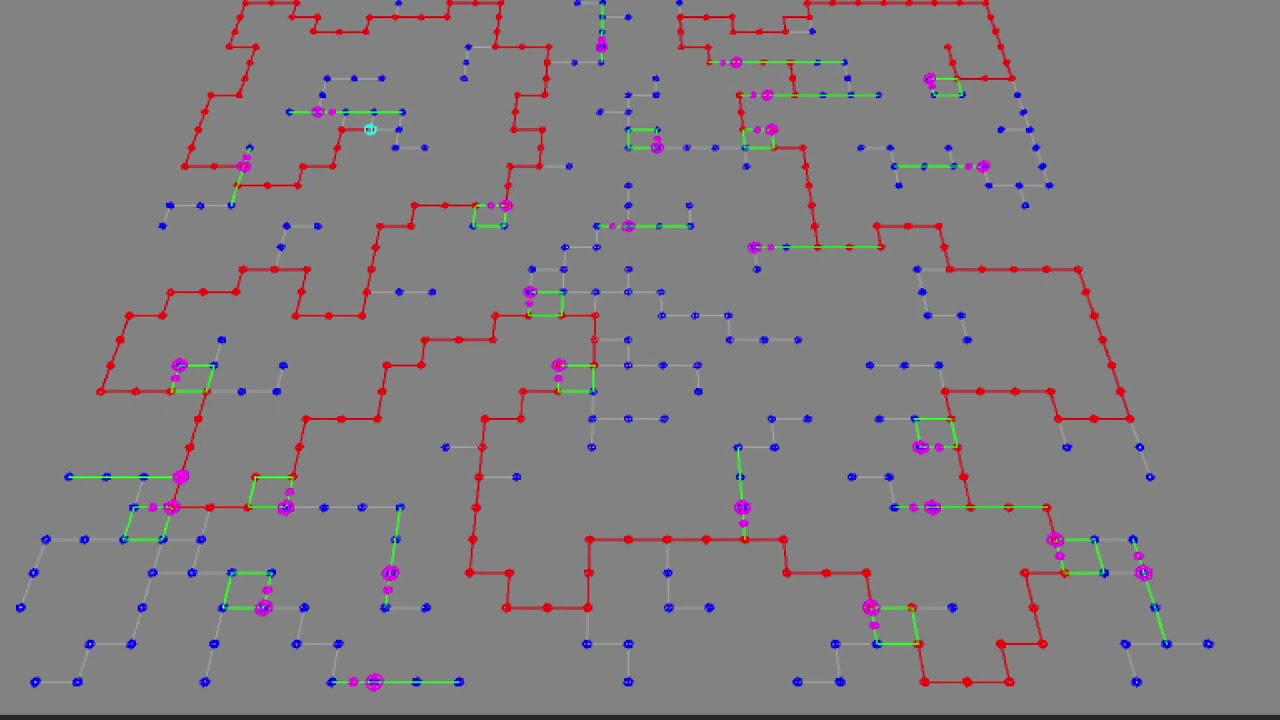
Puzzle Generation
A dungeon generator where monsters trawl on fixed and cyclical paths, creating a looping temporal structure where an agent attempts to reach the end in the shortest amount of forward steps. I developed this using Dijkstra's shortest path algorithm to solve for a sequence of moves in time rather than a shortest traversal path in space, as a final project for a course in algorithmic design.
The People's Tree 2
The second iteration of the People's Tree project, an experimental game where participants design ornaments and leave messages on a communal tree in a shared digital space. For this iteration, I rebuilt the underlying technology, expanded content moderation policies, and added more detailed analytics on player behavior.
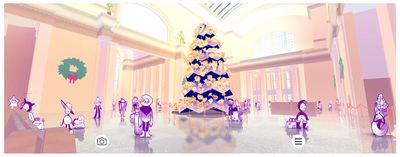
Where's Home?
An experimental game prototype conceived as the next evolution of the People's Tree series. Where previous iterations had players designing ornaments for a shared space, this version reimagined the format around NPCs: players meet characters throughout an abstracted version of Union Station in Chicago, ask them questions, and contribute answers that populate other players' encounters—so the station gradually fills with player-authored characters to discover. The game translated the unshaded, minimalist aesthetic of Rococo into a more detailed architectural style. For the prototype, I developed a custom Rhinoceros plugin to export modular architectural elements, and a separate system to place around 100 unique characters throughout the scene. The project was shelved to allow for more design iteration on its dialogue system.
2 Madvent 2 Calendar
The launcher for the second annual Madvent event, a Haunted PS1 collaboration where ~30 developers release small games daily throughout December. The player navigates a free-floating camera around cabins on a mountain, clicking each to launch its contributed game. With co-developer Vladimere Lhore, I coordinated the project and built the launcher application.
Drip
A dreamlike ball platformer created in one week for the C.H.A.I.N. collaboration. My task was to create a sequel to a first-person hospital game. To meet the deadline, I used Grasshopper for procedural level design, creating a large, open dreamscape where the player floats downwards. This parametric approach allowed me to efficiently place collectibles, asteroids, and hazardous tentacles along splines with random variation, directing the player's movement through the space.
C.H.A.I.N.
An early collaboration by the Haunted PS1 collective, C.H.A.I.N. was an experimental game series with a unique structure: each developer received a game, created a direct sequel, and then passed it to the next person in the chain. I participated in this project, contributing my own entry, "Drip." The unpredictable, flowing narrative worked well, and the experiment's popularity directly led to the creation of a more ambitious sequel, C.H.A.I.N.G.E.D., in 2022.
Rococo
Rococo is my first complete game, built solo in two weeks for the Haunted PS1 Summer of Screams jam. The player bounces on a jelly-like linoleum floor through a child's dream of a deconstructed kitchen, reaching for a floating jar of cookies. Two inputs, three minutes — I focused on making the single interaction feel complete — custom shaders create an unlit, candy-colored look, and a physics-driven sound system ties audio to the player's motion. An epilogue was added days after release in response to players wanting to stay in the world. Rococo reached 4.6★ across 218 ratings with 109 comments over five years of organic discovery — more individual ratings than any Haunted PS1 collective release except the two flagship Demo Discs.
Minotaur
Minotaur is a digital marble maze inspired by the classic BRIO Labyrinth board game, where players tilt a board to navigate a ball around holes. It also served as my earliest experiment with embedded analytics—I built a system that records play sessions and sends summary data to a Clowder data repository. This work enabled long-term data collection, and the results from over three years and thousands of play sessions are analyzed in this report.
The Madvent Calendar
The launcher for the inaugural Madvent event in 2020, an annual Haunted PS1 collaboration where ~30 developers release small games daily throughout December. The player navigates a free-floating camera around a pile of houses stacked in the shape of a tree—an advent calendar where each house is a contributed game that unlocks on its calendar day. I coordinated the project and built the launcher—an application that compiles builds from all contributors, unifies the experience, and manages launching, monitoring, and progress tracking across the full collection.
The People's Tree
The People's Tree was the first in a series of experimental games I created to explore community building in networked spaces. In this project, players design ornaments and leave messages on a shared tree. It was my first opportunity to build the underlying technology, develop content policies, and run analytics for a live, public-facing application. A key finding from this and subsequent projects was an unexpectedly high player return rate of 15-30%, suggesting that players felt a personal stake in the collectively-designed artifact and returned to observe its evolution.
Sloppy Joe
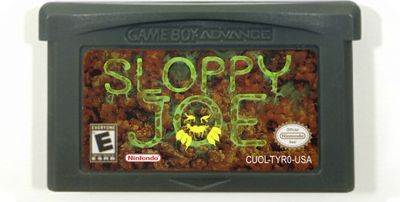
A prototype for a dungeon crawler set in the world of Rococo (my earlier surreal kitchen platformer), created to test a unique ground-based movement mechanic. In this demo, I implemented a system where the player navigates on a rolling seat, bouncing off walls and turning in 90-degree increments. The project was also an experiment in pushing the Rococo aesthetic in a darker visual direction. The prototype can be played here.
Nightmare House 2
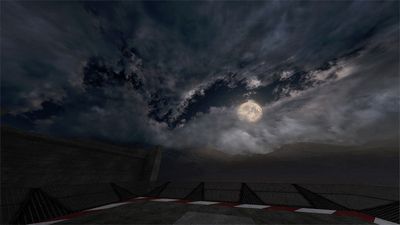
A skybox for a free horror indie game that replaces the outside environment, working at ground level and when on top of a tall tower. I created the skybox using a combination of Vue rendering and photocollage with a program called Skypaint which manages perspective-correction when editing.