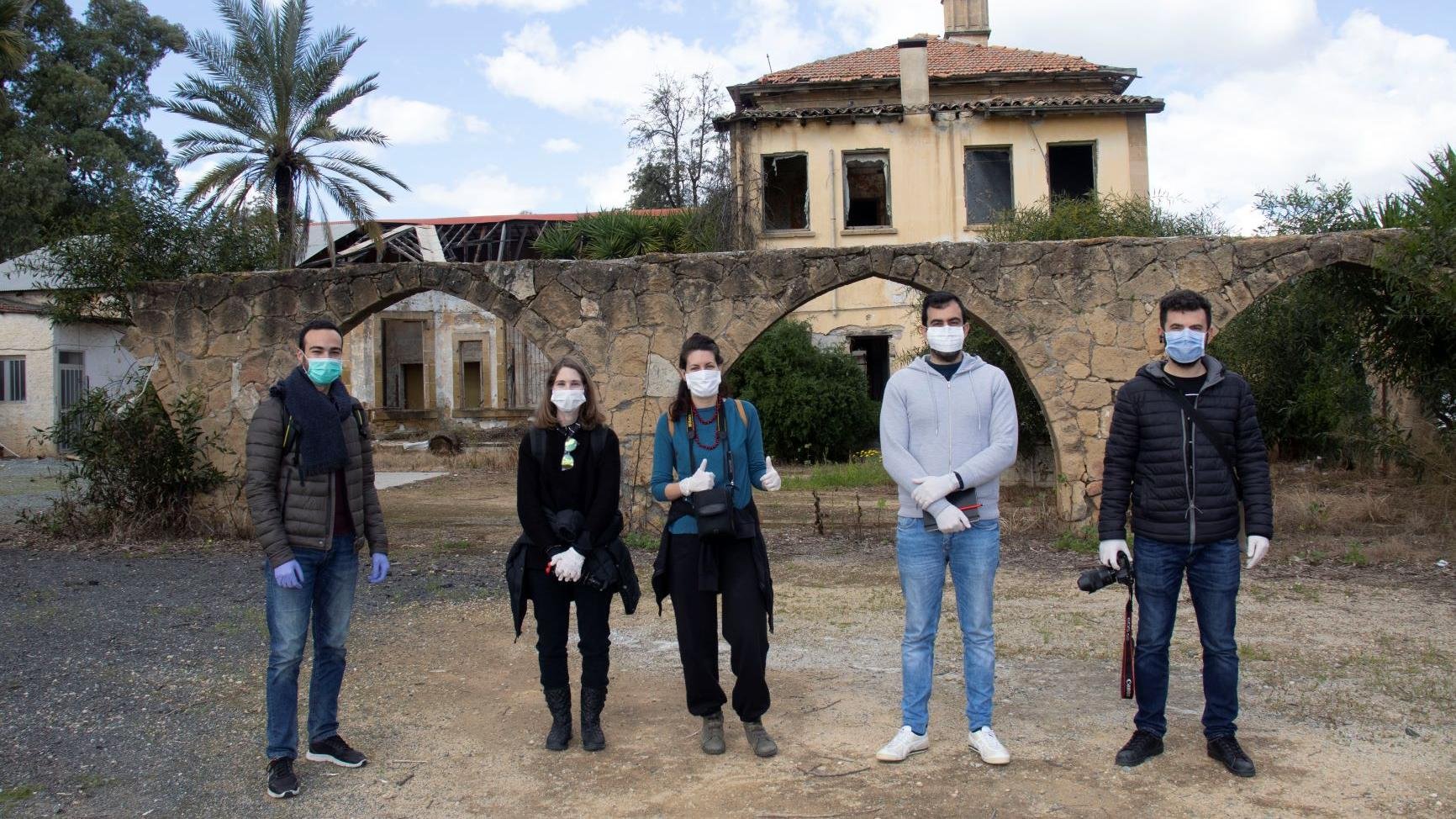
BEEP Energy Sim
An AR energy-use visualization that lets stakeholders view expected energy loads for every room in a heritage building over the year using a phone or tablet. A slider scrubs through a full year of data, built to explain green infrastructure investments for the adaptive reuse project. More information on the project can be found here. ↗
Technical: I baked 3D room volumes into an optimized mesh whose vertex UVs encode positions on a packed lookup texture for GPU-driven animation without CPU overhead. The project also showcased Wikar's 3D section slicer, which recomposes standard shaders into slicable equivalents using 3D SDF intersections with a stencil pass for back-face fill.
Related Projects
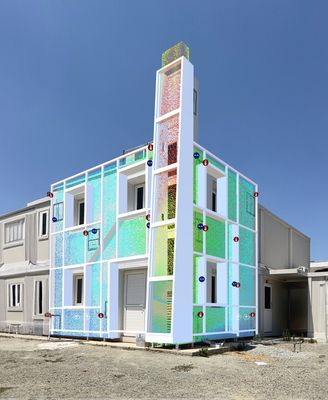
MESH AIRFLOW Visualization
An AR visualization of airflow patterns for a secondary facade system designed by the Cyprus Institute. I took the researchers' 2D computational fluid dynamics (CFD) simulations (heat and flow maps) and UV mapped them onto a 1:1 scale 3D model of the facade, then built a shader to animate these maps with particles, inspired by how Portal 2 visualizes fluid dynamics. In the final application, users scan a QR code on the test building and see the internal 'stack effect' in action, with callouts indicating sensor locations.
Earth Vis
An experiment in converting NASA climate data into a real-time VFX graph visualization. For this project, I built a system in Unity where a compute shader drives particles across a globe in polar coordinates, sampling precomputed flowmaps for wind speed and direction, while their trails change color based on temperature.
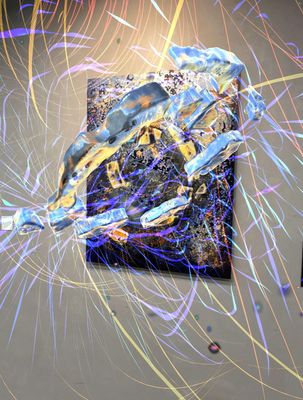
CryoLumens
An AR artwork representing the strength and location of Earth's magnetic fields using NASA's real-time sensor network, overlaying data-driven particle systems on an original painting using image tracking. When viewed through a phone, the painting comes alive with particles that shift and flow based on live magnetic field data. I developed the coding and visuals for Eli Joteva.Technical: Live sensor intensities are baked into packed textures so particles animate by interpolating a texture index on the GPU, keeping the visualization real-time without CPU overhead.
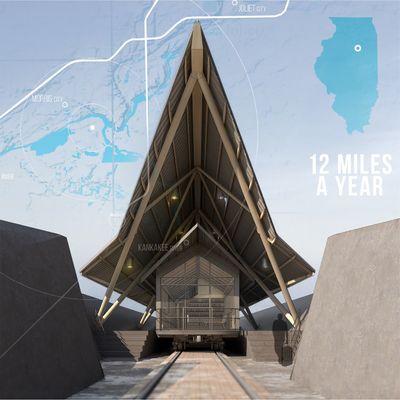
12 Miles a Year
Archon Studio Prize (2nd Place), 2018An architectural proposal that reclaims industrial infrastructure for habitation, this was my winning entry for the Archon Studio of 2018. Developed with the supervision of Olsen-Kundig Studio and professor Carl Lewis, the project drew inspiration from the post-industrial landscapes of the Midwest, particularly those of early nuclear research and energy production. Dresden Generating Station—the first privately financed nuclear power plant in the U.S. and a keystone of postwar energy optimism—sits within a landscape where rail lines, river corridors, and prairie converge. This terrain carries the histories of industry, energy, and abandonment. By re-inhabiting its disused rail lines, the project reclaims infrastructure not for transit or commerce but for reflection and habitation, transforming industrial remnants into a framework for living. Rather than treating movement as speed or efficiency, the project reframes locomotion as a slow inhabitation of landscape. Its propulsion system borrows from the mechanics of a grandfather clock, scaled up into a pendulum, counterweights, and a 1.5-meter winding wheel. Each day, residents wind the mechanism to power the ultra-slow drive, where a heavy steel "foot" presses against the ground to move the house forward. Built on the reclaimed steel frame of boxcars, the house unfolds as a linear sequence—private quarters, dining, power, and communal spaces—that extend dwelling into a year-long passage across prairie, rivers, marshland, and ruins. In place of the forward thrust of rail or the concentrated energy of nuclear power, the project proposes a cyclical, patient mode of inhabiting the landscape. The house becomes a way to read its environment slowly, reframing abandoned infrastructure as a stage for observation and ritual.