Publications
I research how playable software can produce new knowledge between scholars, institutions, and communities. Game design is a growing practice in academia and meets growing games literacy in the public, but we lack methodologies that operationalize making and play as collaborative humanistic inquiry. My dissertation contributes propositional modeling, a methodology where digital artifacts trigger divergent interpretation and accumulate what that interpretation yields, so that public play compounds knowledge scholars can’t produce alone.
About
I research how playable software can produce new knowledge between scholars, institutions, and communities. Game design is a growing practice in academia and meets growing games literacy in the public, but we lack methodologies that operationalize making and play as collaborative humanistic inquiry. My dissertation contributes propositional modeling, a methodology where digital artifacts trigger divergent interpretation and accumulate what that interpretation yields, so that public play compounds knowledge scholars can’t produce alone.
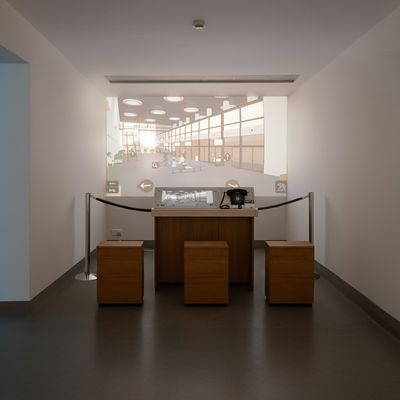
Nicosia International Airport VE
A museum installation featuring a reconstructed 3D model of Nicosia International Airport's modern terminal based on LiDAR scans and archival documentation, housed in a custom-designed wooden console with touchscreen navigation and immersive projection. I developed the participatory virtual environment to test dissertation methodologies on co-constructive virtual places for heritage, featuring a "propositional model" for directing public knowledge toward architectural features, and a period landline phone interface for oral story contribution. I also designed and developed the companion website at velab.cloud/nic/en. Deployed in a public exhibition at the Bank of Cyprus Cultural Foundation, the project captured over 3,200 play sessions and 300 oral story recordings, generating new qualitative data that expands and challenges the site's limited documentation. See the development timeline for in-progress screenshots and photos.
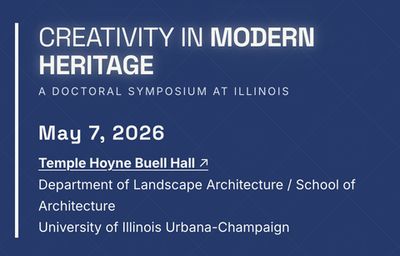
Creativity in Modern Heritage: A Doctoral Symposium
An interdisciplinary doctoral symposium on modern heritage that I co-chaired and designed the website for. Held on May 7, 2026 at Temple Hoyne Buell Hall, the event featured a keynote lecture by Hi'ilei Julia Hobart (Yale) and six papers, jointly supported by the PhD Programs in Architecture and Landscape Architecture and History + Theory + Preservation, with co-sponsors including the Unit for Criticism and Interpretive Theory, the Environmental Humanities Research Cluster, the American Indian Studies Program, and the Sawyer Seminars. I also presented my paper, 'Propositional Modeling for Digital Heritage: Committed Artifacts, Situated Knowledges,' at the symposium.
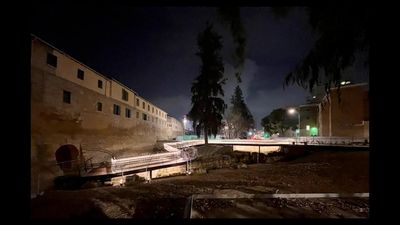
Paphos Gate: Nicosia
Multiple VR applications (using Oculus DK2 and HTC Vive) to visualize archaeological findings and a proposed architectural intervention for an urban archaeology project in Nicosia. I prototyped and built the applications as a research assistant, developing systems for locomotion, interaction, and gaze-tracking analytics to understand how stakeholders focused on the virtual site. These tools engaged everyone from the public to the Department of Antiquities. The gaze-tracking data directly informed the design of the final public walkway and was integrated into the permanent VR exhibit at the museum. The project spanned a decade before the site and its permanent VR exhibit opened to the public in 2024.
Quantum Itineraries Live Visuals
A suite of tools and visualizations in Unity for live-generated 3D visuals projected behind performers at 8K for dome or classical displays, using procedurally generated meshes and shaders. I built the system for the Quantum Itineraries music performances, a festival featuring quantum computer music where quantum simulations are core to composition and instrumentation. The quantum simulation data that generated the music also drove the visuals directly, with WebRTC routing Unity's output to a mixer for the projection.
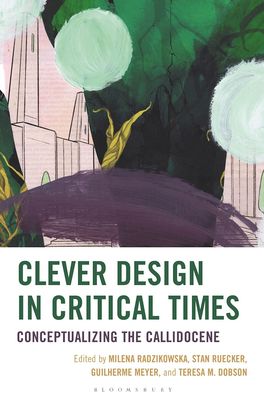
Are Surveys Necessary? Designing Virtual Environments for Participatory Research
A prototype Virtual Environment (VE) designed as an immersive online 'guest book' where hundreds of users could asynchronously decorate a shared virtual space and leave messages for one another. I developed this VE for a workshop on the intangible cultural heritage of Córdoba's communal patios, introducing key design strategies for asynchronous interaction ('claims' and 'traces') and a novel workflow using Large Language Models (LLMs) to automate qualitative coding and moderation of text contributions. Published as a book chapter in the 2025 Bloomsbury Academic volume, Clever Design in Critical Times: Conceptualizing the Callidocene, arguing that interactive VEs can serve as effective tools for participatory research beyond traditional surveys in the Digital Humanities. The book is available from Bloomsbury Academic.
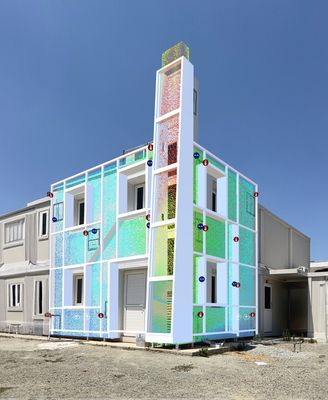
MESH AIRFLOW Visualization
An AR visualization of airflow patterns for a secondary facade system designed by the Cyprus Institute. I took the researchers' 2D computational fluid dynamics (CFD) simulations (heat and flow maps) and UV mapped them onto a 1:1 scale 3D model of the facade, then built a shader to animate these maps with particles, inspired by how Portal 2 visualizes fluid dynamics. In the final application, users scan a QR code on the test building and see the internal 'stack effect' in action, with callouts indicating sensor locations.
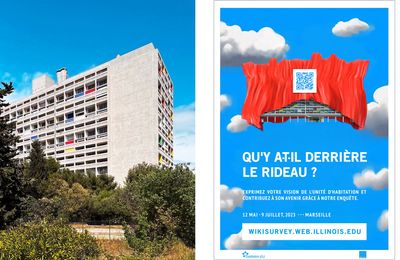
Unité d'Habitation Wikisurvey
A wiki survey tool—a survey format where participants both vote on and submit new options, so the survey evolves as people interact with it. This implementation draws on two prior systems (All Our Ideas and POLIS) and adds AI-assisted seed generation and automated qualitative coding. I developed this web application as part of the MetaFraming research.
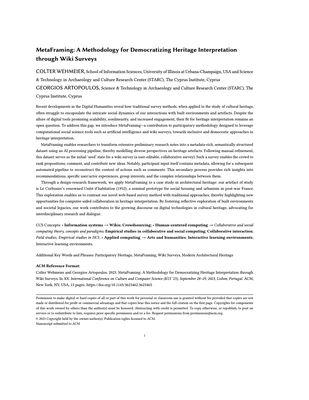
MetaFraming: A Methodology for Democratizing Heritage Interpretation through Wiki Surveys
A participatory methodology for heritage study using AI-assisted wiki surveys, a technology from the computational social sciences that allows the survey itself to evolve as people interact with it. I developed MetaFraming using three distinct GPT-3.5 pipelines: one generates hundreds of 'seed' propositions from background research (controlled for tone and topic), another interprets user-submitted comments by providing contextual history of their interactions, and a third automatically codes comments for sentiment and topics to speed qualitative analysis and aid abuse detection. The methodology was developed through a case study on Le Corbusier's Unité d'habitation and published as a conference paper. Read the full paper here.
BEEP Energy Sim
An AR energy-use visualization that lets stakeholders view expected energy loads for every room in a heritage building over the year using a phone or tablet. A slider scrubs through a full year of data, built to explain green infrastructure investments for the adaptive reuse project. More information on the project can be found here.Technical: I baked 3D room volumes into an optimized mesh whose vertex UVs encode positions on a packed lookup texture for GPU-driven animation without CPU overhead. The project also showcased Wikar's 3D section slicer, which recomposes standard shaders into slicable equivalents using 3D SDF intersections with a stencil pass for back-face fill.
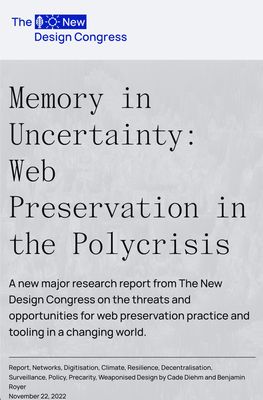
Memory In Uncertainty
A New Design Congress report exploring the techno-political implications of web archiving practices, focusing specifically on our contradictory impulses to both preserve web culture at scale, and also respect people's right to be forgotten. I contributed as a reviewer for the public release, which built out from several private reports produced by NDC. Also featured in the Neural Networks contributor archive.
"Patio Walk": Córdoba
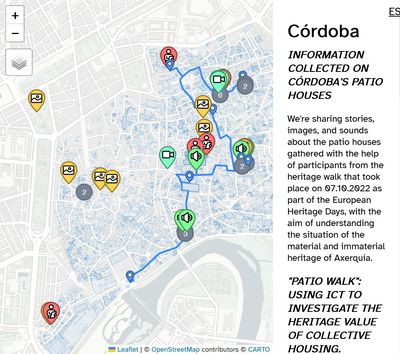
A pair of web applications for a Dariah Udigish Working Group project on the intangible cultural heritage of Córdoba's communal patios. The first was a site-specific recording tool for field workers that automatically linked photos, texts, audio interviews, and surveys to their GPS locations in a GIS database. The second was an interactive map-based visualization that displayed all collected materials overlaid on the city's patios. As a member of the working group, I was responsible for the design and development of both the data collection and final visualization tools.
"Scan To Ar": Palermo
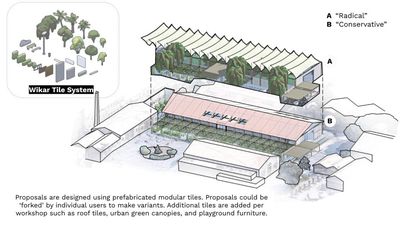
A co-design workshop using rapid 3D site capture and an AR design tool with a library of design primitives (akin to Lego bricks). The goal was to repurpose abandoned industrial heritage in Palermo. I collaborated with Federico La Russa to facilitate the workshop, using Wikar (my augmented reality platform) to swiftly mock up and review architectural proposals with stakeholders over a single weekend. The co-design process helped the local campus community collect a public voice for preserving the open space, and the site opened as a public space in October 2022. Conference presentation and publication documented the methodology.
Córdoba Court
Córdoba Court is a social game I designed and developed as the third iteration of the People's Tree series, modeled after the communal patios of Córdoba, Spain. Players cultivate a shared virtual environment by designing personalized totems from a combinatorial system of parts. The project was released simultaneously through the Haunted PS1 community and as part of the DARIAH Udigish Working Group's survey on Córdoba's communal patios, serving as a social experiment in shared digital space and community greening. A report is also available, which analyzes player content and observed behaviors.
ICT For Urban Heritage: Palermo
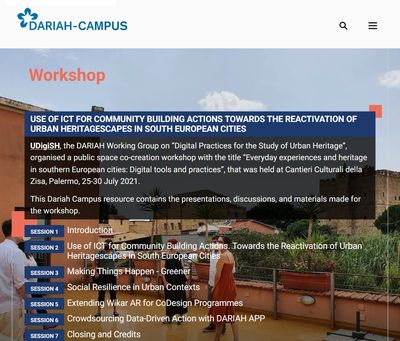
A co-design workshop in Palermo to envision the future of an abandoned warehouse, serving as the first field test for my dissertation research on propositional modeling. I designed two competing architectural proposals (conservative and radical) and used my AR platform, Wikar, to allow local stakeholders to view them on-site. By testing the proposals at different scales (a 1:500 map vs. 1:1 walkthroughs), the process surfaced the community's deep attachment to the site's recent, unwritten history as a local park. This visualization work gave their tacit knowledge an empirical basis, and the feedback directly informed the final design, which preserved the area as a public plaza.
Minotaur
Minotaur is a digital marble maze inspired by the classic BRIO Labyrinth board game, where players tilt a board to navigate a ball around holes. It also served as my earliest experiment with embedded analytics—I built a system that records play sessions and sends summary data to a Clowder data repository. This work enabled long-term data collection, and the results from over three years and thousands of play sessions are analyzed in this report.