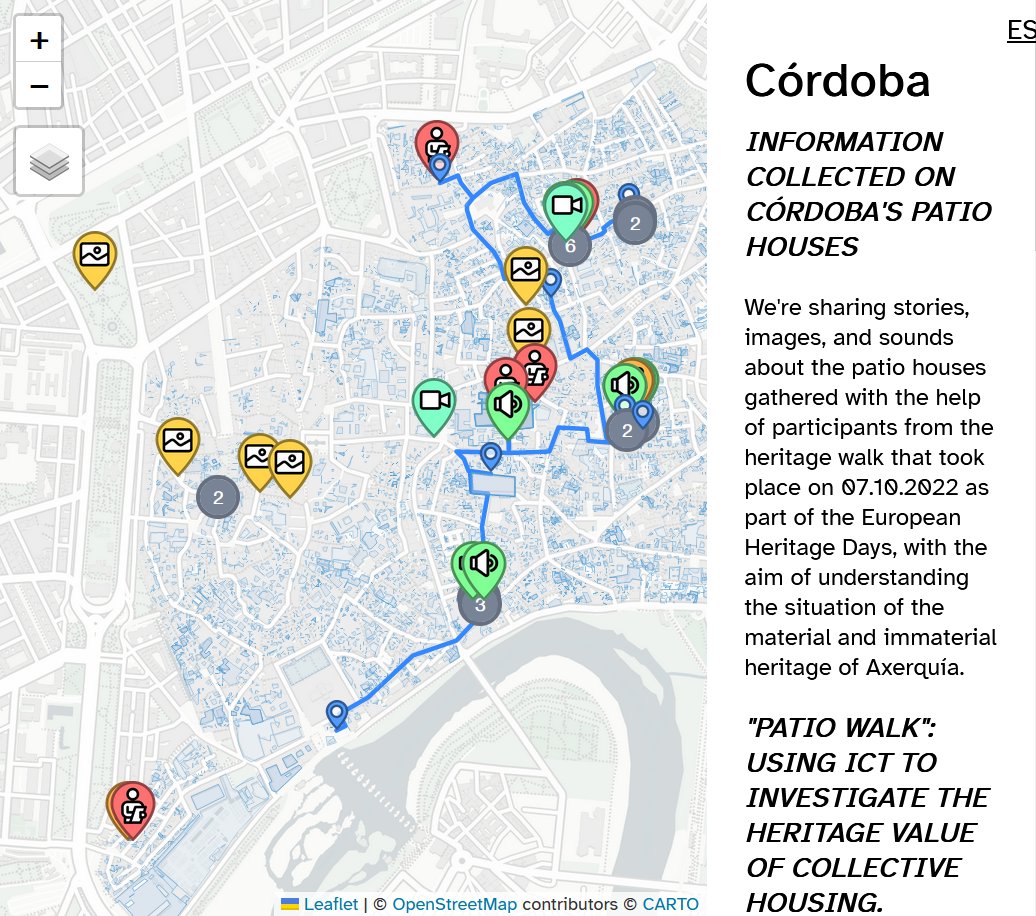
"Patio Walk": Córdoba
A pair of web applications for a Dariah Udigish Working Group project on the intangible cultural heritage of Córdoba's communal patios. The first was a site-specific recording tool for field workers that automatically linked photos, texts, audio interviews, and surveys to their GPS locations in a GIS database. The second was an interactive map-based visualization that displayed all collected materials overlaid on the city's patios. As a member of the working group, I was responsible for the design and development of both the data collection and final visualization tools.
Related Projects
Córdoba Court
Córdoba Court is a social game I designed and developed as the third iteration of the People's Tree series, modeled after the communal patios of Córdoba, Spain. Players cultivate a shared virtual environment by designing personalized totems from a combinatorial system of parts. The project was released simultaneously through the Haunted PS1 community and as part of the DARIAH Udigish Working Group's survey on Córdoba's communal patios, serving as a social experiment in shared digital space and community greening. A report is also available, which analyzes player content and observed behaviors.
ICT For Urban Heritage: Palermo
A co-design workshop in Palermo to envision the future of an abandoned warehouse, serving as the first field test for my dissertation research on propositional modeling. I designed two competing architectural proposals (conservative and radical) and used my AR platform, Wikar, to allow local stakeholders to view them on-site. By testing the proposals at different scales (a 1:500 map vs. 1:1 walkthroughs), the process surfaced the community's deep attachment to the site's recent, unwritten history as a local park. This visualization work gave their tacit knowledge an empirical basis, and the feedback directly informed the final design, which preserved the area as a public plaza.
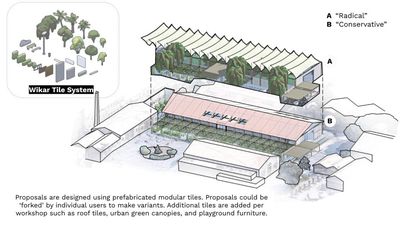
"Scan To Ar": Palermo
A co-design workshop using rapid 3D site capture and an AR design tool with a library of design primitives (akin to Lego bricks). The goal was to repurpose abandoned industrial heritage in Palermo. I collaborated with Federico La Russa to facilitate the workshop, using Wikar (my augmented reality platform) to swiftly mock up and review architectural proposals with stakeholders over a single weekend. The co-design process helped the local campus community collect a public voice for preserving the open space, and the site opened as a public space in October 2022. Conference presentation and publication documented the methodology.
Are Surveys Necessary? Designing Virtual Environments for Participatory Research
A prototype Virtual Environment (VE) designed as an immersive online 'guest book' where hundreds of users could asynchronously decorate a shared virtual space and leave messages for one another. I developed this VE for a workshop on the intangible cultural heritage of Córdoba's communal patios, introducing key design strategies for asynchronous interaction ('claims' and 'traces') and a novel workflow using Large Language Models (LLMs) to automate qualitative coding and moderation of text contributions. Published as a book chapter in the 2025 Bloomsbury Academic volume, Clever Design in Critical Times: Conceptualizing the Callidocene, arguing that interactive VEs can serve as effective tools for participatory research beyond traditional surveys in the Digital Humanities. The book is available from Bloomsbury Academic.