Now
May 2026 · Urbana, IL.
PhDs
Defended my PhD in Informatics at the University of Illinois Urbana-Champaign on May 5, 2026. My second PhD — in Science and Technology in Archaeology and Cultural Heritage at the Cyprus Institute — defends in fall 2026.
Nicosia Airport VE
Preparing the public dataset and release for the Nicosia International Airport virtual environment ↗ that anchored my dissertation, so the framework, data, and analysis tooling are reusable by others studying participatory heritage interpretation.
Continuing in Urbana
Existing projects continue and new ones are starting. Among them: still building C.H.A.I.N. 3 ↗ with Adam Pype and the Haunted PS1 ↗ collective.
Last updated May 2026. about /now pages ↑ ↗
Related Projects
SOUP ROOMS: Sodium
An atmospheric exploration room created for SOUP ROOMS (2025), a virtual gallery system directed by Akuma Kira & Kite Line. SOUP is a rigid creative format lifted from a 2007 artware game; its many subsequent releases now exhibit 300+ rooms, suggesting how set technical constraints can scale participation and reward ingenuity. Contributors define their cube-shaped "rooms" from a fixed set of images and sounds. SOUP-making has been used as a charrette exercise in game design studios, where it can teach the fundamentals of game assets, collaborative work, and creative economy. My contribution, Sodium, places the player in a sodium-lit parking lot on a midsummer night, pairing a soundscape of cicadas and a distant storm with spherical projection mapping to evoke warm light and deep shadow.
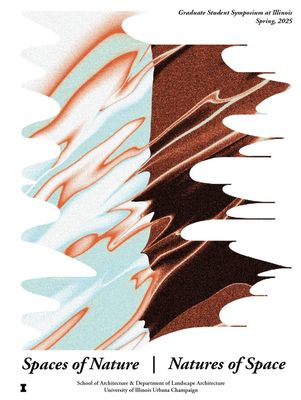
Spaces of Nature/Natures of Space Symposium
A graphic identity and website designed for the 'Spaces of Nature/Natures of Space' graduate student symposium. I created the event's visual identity and designed the official website while co-organizing the symposium with Taisuke Wakabayashi at the University of Illinois Urbana-Champaign. During the symposium, held on February 14, 2025, I presented an early draft of my research paper, 'The Interpretive Nature of Space: Generative Ambiguity in Heritage Visualization'. Abstract In architectural representation, the tension between objectivity and ambiguity opens space for interpretive engagement. Yet contemporary digital visualization practices increasingly prioritize photorealism—a pursuit that, as Lefebvre cautions, risks reducing lived space to a superficial spectacle. Drawing on research conducted at Cyprus's Virtual Environments Laboratory, this paper contends that the nature of space emerges not through visual mimesis but through the generative potential of representational ambiguity. Such an approach aligns virtual reconstructions with the deeper intellectual and cultural aims of the Digital Humanities. The Nicosia International Airport (1968), abandoned in Cyprus's UN buffer zone since 1974, exemplifies the interpretive challenges of modern architectural heritage. Here, meaning is negotiated between design intent, built form, and lived experience. More than a modernist relic of Cyprus's post-colonial aspirations, the site's abrupt abandonment transformed it into a time capsule of what de Certeau terms 'spatial practices': public terraces and amenities overlooking the tarmac once fostered forms of social life unimaginable in today's airports. With these practices now confined to living memory, methodologies are needed that integrate experiential knowledge with conventional documentation.To address this gap, we developed an approach to heritage visualization through a year-long museum installation featuring a virtual reconstruction of the airport set in 1969. By embedding carefully designed 'interpretation gaps'—strategic ambiguities in the visualization—we created a system that invites visitors to actively bridge these gaps through their contributions: memories, media, and historical knowledge. In this way, the virtual environment becomes both a research instrument and a medium for collective storytelling, supporting rather than supplanting the social practices that sustain collective memory.
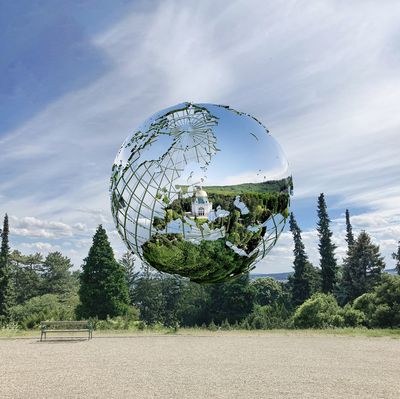
Otto Wagner Areal - Peter Kogler
An AR sculpture garden featuring Peter Kogler's unmade digital sculptures at Wiener Gesundheitsverbund, an Otto Wagner-designed early 20th century medical campus now reused as a university and culture campus. I served as technical producer, taking the artist's intricate 3D meshes, creating site-specific shaders to simulate reflection and lighting, and working on-site with Kogler to place, scale, and rotate the virtual works. I added features to Wikar for real-time metadata syncing from our Clowder server, enabling the rapid placement of eight complex sculptures in a single day. Part of a promotional event.
Constraints, Not Freedom: Designing Virtual Environments for Distributed Co-Creation
A poster and live-demo presentation at the IMMERSE Symposium 2026 (April 28-29, University of Illinois Urbana-Champaign), introducing five productive constraint patterns - spatial, propositional, relational, technical, thematic - as a typology for designing user-generated-content systems. Drawing on a decade of design-research across Nicosia International Airport VE, C.H.A.I.N. 3, Soap Soup, the Haunted PS1 demo discs, and Wikar, the work argues that maximizing user freedom can paradoxically undermine the creative economy in which participants engage. The booth presented two live demos: Soap Soup (technical constraint) on a CRT and the Nicosia Airport VE (propositional constraint) on a laptop. Supplement page hosts the full abstract, partner credits, analogous-pattern links, and project context.