Exhibitions: art
I design things to support my work and others: exhibitions, architecture, furniture, hardware, and graphics. Making is a form of study—combining traditional techniques with new technologies to find low-cost, DIY methods that yield surprising qualities. I like artifacts that straddle boundaries: virtual/physical, analogue/digital, traditional/progressive.
About
I design things to support my work and others: exhibitions, architecture, furniture, hardware, and graphics. Making is a form of study—combining traditional techniques with new technologies to find low-cost, DIY methods that yield surprising qualities. I like artifacts that straddle boundaries: virtual/physical, analogue/digital, traditional/progressive.
Quantum Itineraries Live Visuals
A suite of tools and visualizations in Unity for live-generated 3D visuals projected behind performers at 8K for dome or classical displays, using procedurally generated meshes and shaders. I built the system for the Quantum Itineraries music performances, a festival featuring quantum computer music where quantum simulations are core to composition and instrumentation. The quantum simulation data that generated the music also drove the visuals directly, with WebRTC routing Unity's output to a mixer for the projection.
Eva Schlegel
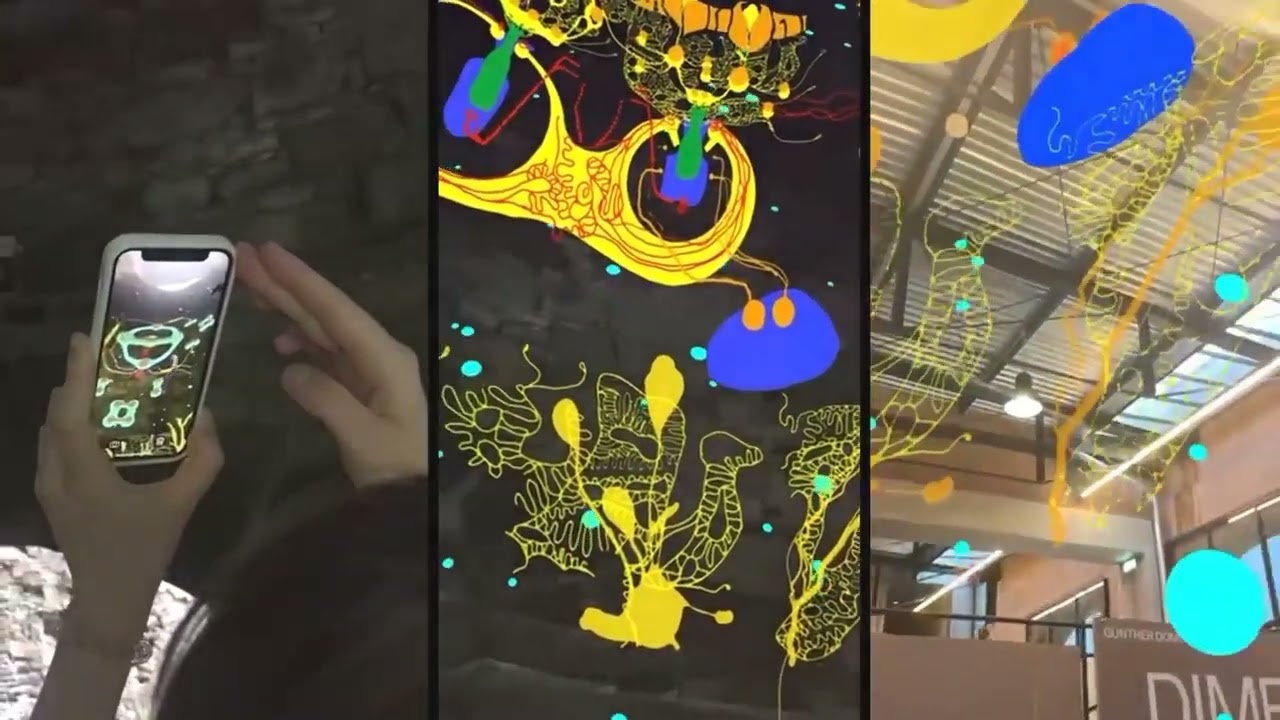
Public AR installations for artist Eva Schlegel's studio, featuring complex custom shaders developed by her team. My role was to provide the technical education and platform support to make this possible. I extended the Wikar platform with new capabilities specifically for this project, including support for stencil shaders, UI compositing, and safeguarding access to camera textures and other rendering features that Unity would typically strip from a build.
Other Matter
An AR exhibition with Valerie Messini and her students at the University of Applied Arts in Vienna. To support the students' creation of interactive and reactive sculptures, I extended the Wikar platform with several new features. This included more robust QR code scanning (improving reliability for inverted codes), expanded UI customization options, and a set of "interaction primitives" that students could use for proximity-based events or custom user controls. A video of the exhibition can be seen here.
Augmented Dreams: AR Sculpture Park
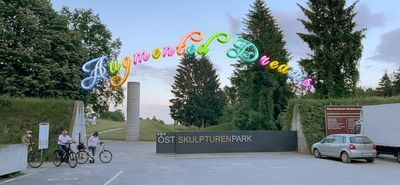
An AR sculpture park for a public exhibition in Graz, Austria, layering digital works by MFA students onto an existing physical sculpture park. As the selected technical producer, I provided Wikar for its openness and spatial accuracy. The students created site-specific works, some of which extended existing physical sculptures in interesting ways. To meet the high demand for documentation from both students and visitors, I improved Wikar's performance and added new photo and video recording capabilities to the app.
Erwin Wurm
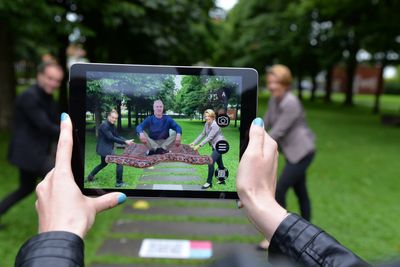
An AR deployment of Erwin Wurm's sculptural works in new contexts using augmented reality. I worked with Studio Calas in an educational and technical capacity, training their team on how to prepare and optimize 3D models for the Wikar platform and its upload pipeline while they handled photogrammetry and content creation. At their request, I also made Wikar's QR code scanning more robust for outdoor environments and for use with different colored tags.
CryoLumens
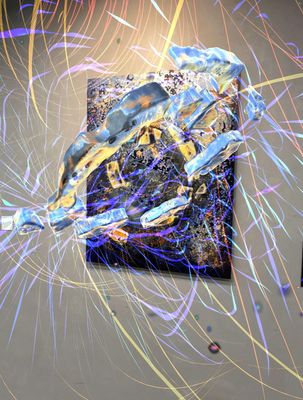
An AR artwork representing the strength and location of Earth's magnetic fields using NASA's real-time sensor network, overlaying data-driven particle systems on an original painting using image tracking. When viewed through a phone, the painting comes alive with particles that shift and flow based on live magnetic field data. I developed the coding and visuals for Eli Joteva.Technical: Live sensor intensities are baked into packed textures so particles animate by interpolating a texture index on the GPU, keeping the visualization real-time without CPU overhead.
Timeline Atlas
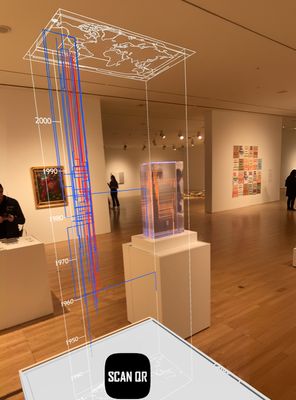
Two AR data-visualization sculptures visualizing datasets too complex to depict through physical sculpture: the home locations of all female senators over the past century. I collaborated with artist Stephen Cartwright, known for meticulously logging personal data over decades and crafting it into acrylic sculptures that exhibit spatial-temporal patterns. We used AR to go beyond his traditional manufacturing techniques. Debuted as part of a faculty showcase in 2019.
Bezeliness Intensifies
A series of light sculptures and pen-plotted transparent graphics exploring the aesthetics of frames and bezels through space-filling curves, packing algorithms, and reaction-diffusion simulations. The work blended 3D printing, pen plotting, reactive lighting, and other digital production techniques. It was installed in three locations: the UIUC School of Architecture, the Broadway Food Hall, and a six-month window display on Urbana's main street.
Quipit Student Survey
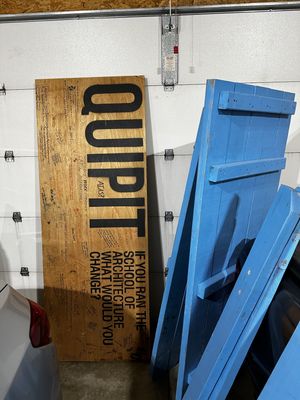
A participatory table installation in the school's atrium that challenged passersby with the question: What would you change if you ran the school? Over a month, the table filled with students' handwritten responses. QUIPIT—a student group in the University of Illinois' School of Architecture, with Ray Majewski, Christian Pepper, and Robert Prochaska—then held a student event to discuss the responses and presented findings to the school's director. Part of our ongoing use of tongue-in-cheek installation art to open conversation among students, faculty, and administration.