Architecture: design
I design things to support my work and others: exhibitions, architecture, furniture, hardware, and graphics. Making is a form of study—combining traditional techniques with new technologies to find low-cost, DIY methods that yield surprising qualities. I like artifacts that straddle boundaries: virtual/physical, analogue/digital, traditional/progressive.
About
I design things to support my work and others: exhibitions, architecture, furniture, hardware, and graphics. Making is a form of study—combining traditional techniques with new technologies to find low-cost, DIY methods that yield surprising qualities. I like artifacts that straddle boundaries: virtual/physical, analogue/digital, traditional/progressive.
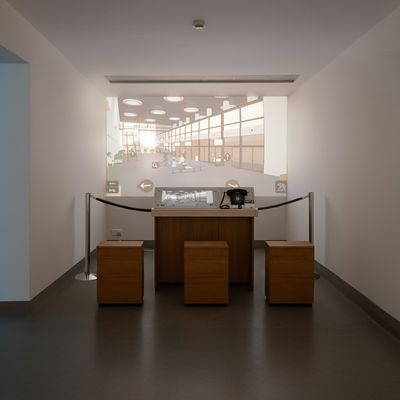
Nicosia International Airport VE
A museum installation featuring a reconstructed 3D model of Nicosia International Airport's modern terminal based on LiDAR scans and archival documentation, housed in a custom-designed wooden console with touchscreen navigation and immersive projection. I developed the participatory virtual environment to test dissertation methodologies on co-constructive virtual places for heritage, featuring a "propositional model" for directing public knowledge toward architectural features, and a period landline phone interface for oral story contribution. I also designed and developed the companion website at velab.cloud/nic/en. Deployed in a public exhibition at the Bank of Cyprus Cultural Foundation, the project captured over 3,200 play sessions and 300 oral story recordings, generating new qualitative data that expands and challenges the site's limited documentation. See the development timeline for in-progress screenshots and photos.
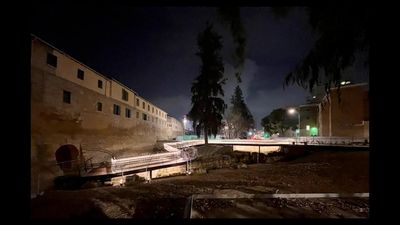
Paphos Gate: Nicosia
Multiple VR applications (using Oculus DK2 and HTC Vive) to visualize archaeological findings and a proposed architectural intervention for an urban archaeology project in Nicosia. I prototyped and built the applications as a research assistant, developing systems for locomotion, interaction, and gaze-tracking analytics to understand how stakeholders focused on the virtual site. These tools engaged everyone from the public to the Department of Antiquities. The gaze-tracking data directly informed the design of the final public walkway and was integrated into the permanent VR exhibit at the museum. The project spanned a decade before the site and its permanent VR exhibit opened to the public in 2024.
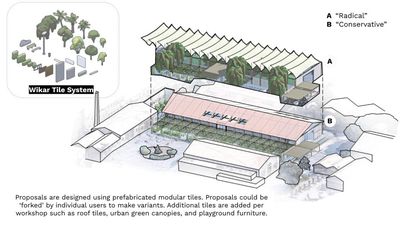
"Scan To Ar": Palermo
A co-design workshop using rapid 3D site capture and an AR design tool with a library of design primitives (akin to Lego bricks). The goal was to repurpose abandoned industrial heritage in Palermo. I collaborated with Federico La Russa to facilitate the workshop, using Wikar (my augmented reality platform) to swiftly mock up and review architectural proposals with stakeholders over a single weekend. The co-design process helped the local campus community collect a public voice for preserving the open space, and the site opened as a public space in October 2022. Conference presentation and publication documented the methodology.
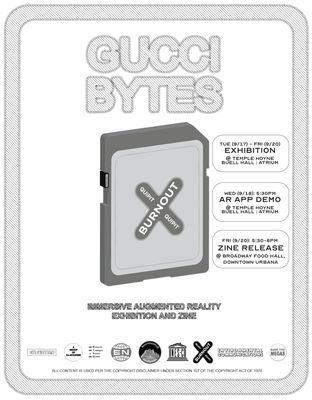
Guccibytes
An exhibition and print zine showcasing unfinished speculative pieces from our studio organization, Quipit, with a focus on revealing the often-unseen digital components of our work. The zine was printed on long scrolls wrapped around PVC lattices, with embedded QR codes linking to AR content in Wikar. Each contributor used the platform differently: some created virtual galleries, others showed complex models on virtual plinths, and I created a "3D portal" to show one of my miniature models staged in its fictional setting. The physical exhibition components were built from materials recycled from a previous project.
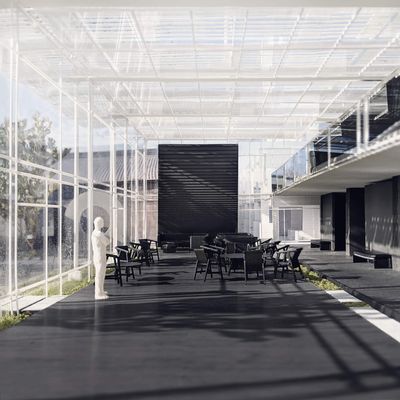
Recovering Urban Memory: Beijing
Chicago Studio Award (First Place), 2019An architectural intervention to redesign an abandoned farmer's market in the historic heart of Beijing's Baitasi District, resurrecting collective spaces such as farmers' markets and cafes that had slowly disappeared from the community fabric. I developed this proposal through the UIUC Plym Studio, exploring lost cultural practices and spaces in the district from the turn of the century through to the late modern period. The studio was led in collaboration with Dong Gong of Vector Architects and Professor Botond Bognar. See an interview about this project with Mayur Mistry.
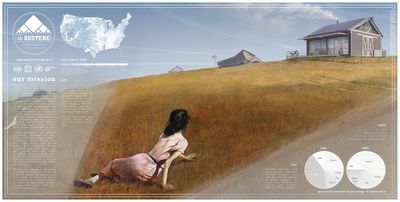
The Austere
CRITICAL MASS Student Choice Award, 2018A speculative project that imagines a near-future of climate catastrophe where corporations provide prefabricated housing tied to labor contracts. Originally a design-build proposal for the U.S. Solar Decathlon, I reformulated the work to explore how speculative design could feel more imminent and unsettling. Instead of distant hyperbole, the project grounded its extreme scenario in plausible economic and social trends, positioning it between architectural proposal, narrative fiction, and propaganda artifact. Exhibited as a large-format presentation board and later as an augmented reality installation, the work won the Student Choice Award at Critical Mass in 2018.
Digital Picnic
A suspended holo-deck-like structure using projectors and a USB controller to adjust the environment with various images, patterns, and colors. I contributed production, assembly, conceptualization, and created visuals and an interactive controller using Arduino and Max/MSP, working with Christian Pepper and Robert Prochaska. We ultimately repurposed the installation into permanent furniture.
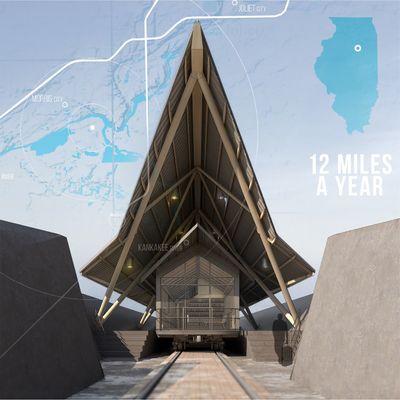
12 Miles a Year
Archon Studio Prize (2nd Place), 2018An architectural proposal that reclaims industrial infrastructure for habitation, this was my winning entry for the Archon Studio of 2018. Developed with the supervision of Olsen-Kundig Studio and professor Carl Lewis, the project drew inspiration from the post-industrial landscapes of the Midwest, particularly those of early nuclear research and energy production. Dresden Generating Station—the first privately financed nuclear power plant in the U.S. and a keystone of postwar energy optimism—sits within a landscape where rail lines, river corridors, and prairie converge. This terrain carries the histories of industry, energy, and abandonment. By re-inhabiting its disused rail lines, the project reclaims infrastructure not for transit or commerce but for reflection and habitation, transforming industrial remnants into a framework for living. Rather than treating movement as speed or efficiency, the project reframes locomotion as a slow inhabitation of landscape. Its propulsion system borrows from the mechanics of a grandfather clock, scaled up into a pendulum, counterweights, and a 1.5-meter winding wheel. Each day, residents wind the mechanism to power the ultra-slow drive, where a heavy steel "foot" presses against the ground to move the house forward. Built on the reclaimed steel frame of boxcars, the house unfolds as a linear sequence—private quarters, dining, power, and communal spaces—that extend dwelling into a year-long passage across prairie, rivers, marshland, and ruins. In place of the forward thrust of rail or the concentrated energy of nuclear power, the project proposes a cyclical, patient mode of inhabiting the landscape. The house becomes a way to read its environment slowly, reframing abandoned infrastructure as a stage for observation and ritual.