Playable: madvent
I ship software people play: video games, apps, and creative infrastructure. I’ve built mixed reality systems for real world exhibitions, cultural heritage, scientific research, and design previsualization. I care about the layers beneath the surface of interactive software—editor tooling, technical art, and performance—and how to design systems that learn from the people who use them.
About
I ship software people play: video games, apps, and creative infrastructure. I’ve built mixed reality systems for real world exhibitions, cultural heritage, scientific research, and design previsualization.
I care about the layers beneath the surface of interactive software—editor tooling, technical art, and performance—and how to design systems that learn from the people who use them.
The People's Sky 2
The fifth iteration of the People's Tree series—where players design items and place them in a shared digital space—developed as the centerpiece for the 2025 Madvent launcher. I was invited by the junior team—who had taken over the launcher technology and coordination—to contribute this game for continuity with the series. My contributions focused on technical refinement: redesigning and optimizing the input system for better panning and zooming, recoloring and reskinning the visual aesthetic, and optimizing data serialization and loading sequences. The project marks my transition from lead developer to technical consultant as the junior team took over coordination.
Madvent 4: End of the Line
The launcher for the 2023 Madvent event, an annual Haunted PS1 collaboration where ~30 creators release games daily throughout December. With co-developer Vladimere Lhore, I created a fully dynamic train that journeys through various biomes and navigates twisting terrain to connect the individual games.
The People's Sky
The fourth iteration of the People's Tree series, The People's Sky is an experimental game where players design items, append messages, and place them in a shared digital sky. A key design change was constraining the color palette to reduce the visual cacophony of earlier iterations. I also developed data-transfer optimizations, analytic logs for post-experiment analysis, a web application for content moderation, and 'trace' visualizations that passively record and display player exploration paths.
Córdoba Court
Córdoba Court is a social game I designed and developed as the third iteration of the People's Tree series, modeled after the communal patios of Córdoba, Spain. Players cultivate a shared virtual environment by designing personalized totems from a combinatorial system of parts. The project was released simultaneously through the Haunted PS1 community and as part of the DARIAH Udigish Working Group's survey on Córdoba's communal patios, serving as a social experiment in shared digital space and community greening. A report is also available, which analyzes player content and observed behaviors.
Madvent Calendar 3: Necrosis
The launcher for the 2022 Madvent event, an annual Haunted PS1 collaboration where ~30 creators release games daily throughout December. Set in a city of skyscrapers, the player clicks stained glass windows on their facades, each window a contributed game. With co-developer Vladimere Lhore, I organized the event and built the launcher application.
The People's Tree 2
The second iteration of the People's Tree project, an experimental game where participants design ornaments and leave messages on a communal tree in a shared digital space. For this iteration, I rebuilt the underlying technology, expanded content moderation policies, and added more detailed analytics on player behavior.
Where's Home?
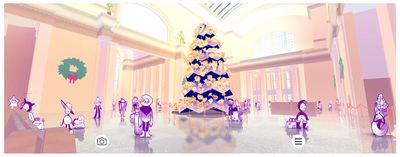
An experimental game prototype conceived as the next evolution of the People's Tree series. Where previous iterations had players designing ornaments for a shared space, this version reimagined the format around NPCs: players meet characters throughout an abstracted version of Union Station in Chicago, ask them questions, and contribute answers that populate other players' encounters—so the station gradually fills with player-authored characters to discover. The game translated the unshaded, minimalist aesthetic of Rococo into a more detailed architectural style. For the prototype, I developed a custom Rhinoceros plugin to export modular architectural elements, and a separate system to place around 100 unique characters throughout the scene. The project was shelved to allow for more design iteration on its dialogue system.
2 Madvent 2 Calendar
The launcher for the second annual Madvent event, a Haunted PS1 collaboration where ~30 developers release small games daily throughout December. The player navigates a free-floating camera around cabins on a mountain, clicking each to launch its contributed game. With co-developer Vladimere Lhore, I coordinated the project and built the launcher application.
The Madvent Calendar
The launcher for the inaugural Madvent event in 2020, an annual Haunted PS1 collaboration where ~30 developers release small games daily throughout December. The player navigates a free-floating camera around a pile of houses stacked in the shape of a tree—an advent calendar where each house is a contributed game that unlocks on its calendar day. I coordinated the project and built the launcher—an application that compiles builds from all contributors, unifies the experience, and manages launching, monitoring, and progress tracking across the full collection.
The People's Tree
The People's Tree was the first in a series of experimental games I created to explore community building in networked spaces. In this project, players design ornaments and leave messages on a shared tree. It was my first opportunity to build the underlying technology, develop content policies, and run analytics for a live, public-facing application. A key finding from this and subsequent projects was an unexpectedly high player return rate of 15-30%, suggesting that players felt a personal stake in the collectively-designed artifact and returned to observe its evolution.