AR/Spatial: ar
I ship software people play: video games, apps, and creative infrastructure. I’ve built mixed reality systems for real world exhibitions, cultural heritage, scientific research, and design previsualization. I care about the layers beneath the surface of interactive software—editor tooling, technical art, and performance—and how to design systems that learn from the people who use them.
About
I ship software people play: video games, apps, and creative infrastructure. I’ve built mixed reality systems for real world exhibitions, cultural heritage, scientific research, and design previsualization.
I care about the layers beneath the surface of interactive software—editor tooling, technical art, and performance—and how to design systems that learn from the people who use them.
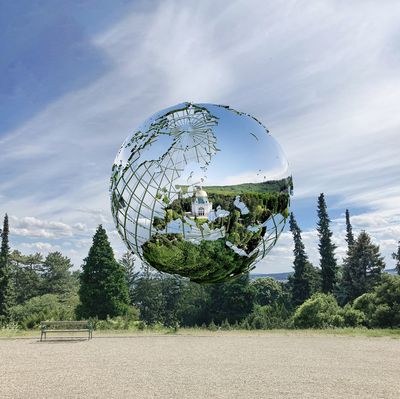
Otto Wagner Areal - Peter Kogler
An AR sculpture garden featuring Peter Kogler's unmade digital sculptures at Wiener Gesundheitsverbund, an Otto Wagner-designed early 20th century medical campus now reused as a university and culture campus. I served as technical producer, taking the artist's intricate 3D meshes, creating site-specific shaders to simulate reflection and lighting, and working on-site with Kogler to place, scale, and rotate the virtual works. I added features to Wikar for real-time metadata syncing from our Clowder server, enabling the rapid placement of eight complex sculptures in a single day. Part of a promotional event.
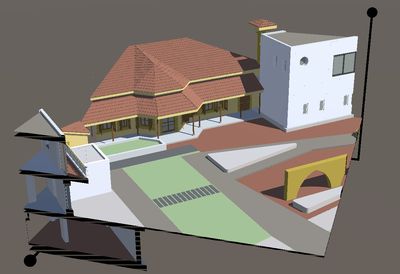
WIKAR v14
A major update to Wikar, my augmented reality platform for viewing 3D content in real-world spaces, for which I developed several key performance and feature improvements in preparation for new AR projects. These included: a multi-tiered caching system to enable offline mode for sculpture gardens; an iterative solver that uses a scan's confidence rating to progressively refine AR placement accuracy; and an optimized mesh slicer system for exploring 3D cross-sections of complex models.
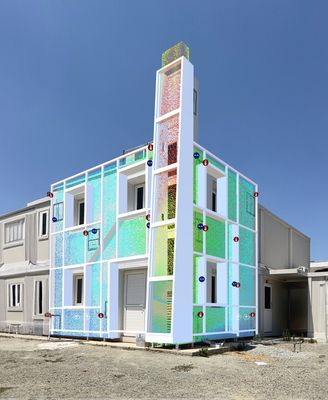
MESH AIRFLOW Visualization
An AR visualization of airflow patterns for a secondary facade system designed by the Cyprus Institute. I took the researchers' 2D computational fluid dynamics (CFD) simulations (heat and flow maps) and UV mapped them onto a 1:1 scale 3D model of the facade, then built a shader to animate these maps with particles, inspired by how Portal 2 visualizes fluid dynamics. In the final application, users scan a QR code on the test building and see the internal 'stack effect' in action, with callouts indicating sensor locations.
BEEP Energy Sim
An AR energy-use visualization that lets stakeholders view expected energy loads for every room in a heritage building over the year using a phone or tablet. A slider scrubs through a full year of data, built to explain green infrastructure investments for the adaptive reuse project. More information on the project can be found here.Technical: I baked 3D room volumes into an optimized mesh whose vertex UVs encode positions on a packed lookup texture for GPU-driven animation without CPU overhead. The project also showcased Wikar's 3D section slicer, which recomposes standard shaders into slicable equivalents using 3D SDF intersections with a stencil pass for back-face fill.
Eva Schlegel
Public AR installations for artist Eva Schlegel's studio, featuring complex custom shaders developed by her team. My role was to provide the technical education and platform support to make this possible. I extended the Wikar platform with new capabilities specifically for this project, including support for stencil shaders, UI compositing, and safeguarding access to camera textures and other rendering features that Unity would typically strip from a build.
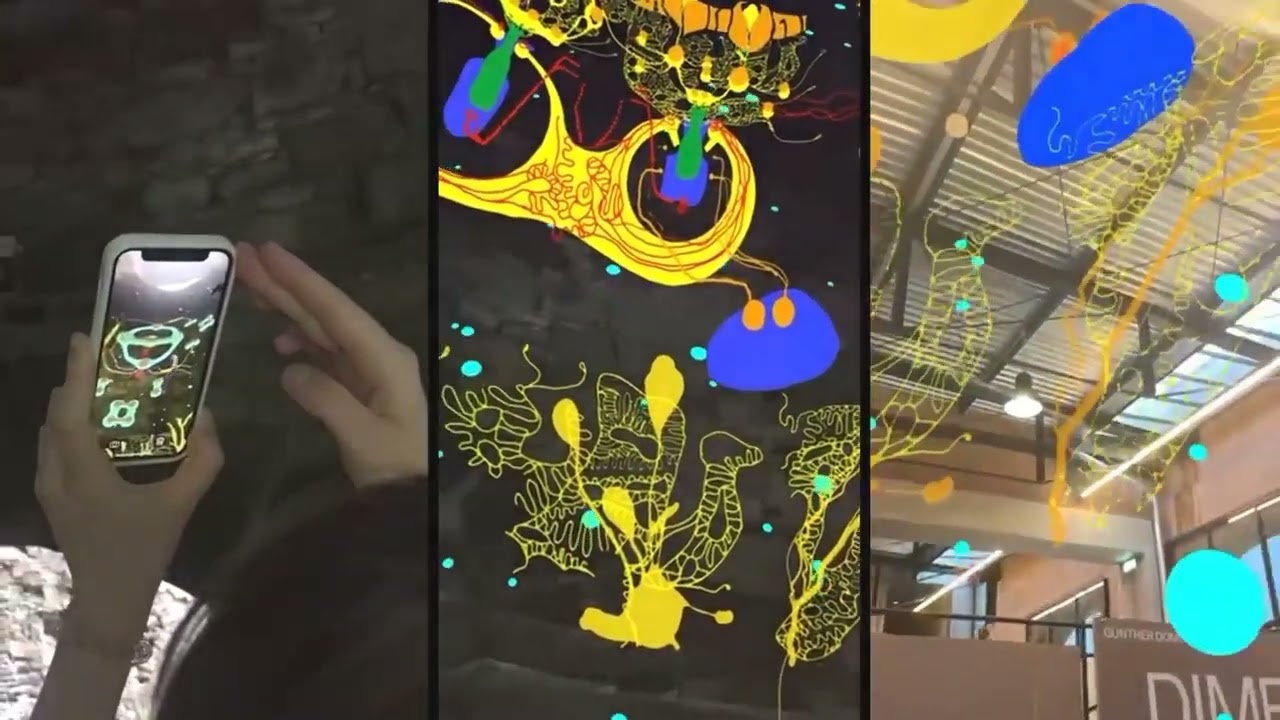
Other Matter
An AR exhibition with Valerie Messini and her students at the University of Applied Arts in Vienna. To support the students' creation of interactive and reactive sculptures, I extended the Wikar platform with several new features. This included more robust QR code scanning (improving reliability for inverted codes), expanded UI customization options, and a set of "interaction primitives" that students could use for proximity-based events or custom user controls. A video of the exhibition can be seen here.
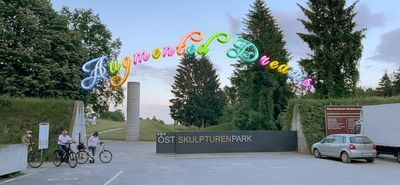
Augmented Dreams: AR Sculpture Park
An AR sculpture park for a public exhibition in Graz, Austria, layering digital works by MFA students onto an existing physical sculpture park. As the selected technical producer, I provided Wikar for its openness and spatial accuracy. The students created site-specific works, some of which extended existing physical sculptures in interesting ways. To meet the high demand for documentation from both students and visitors, I improved Wikar's performance and added new photo and video recording capabilities to the app.
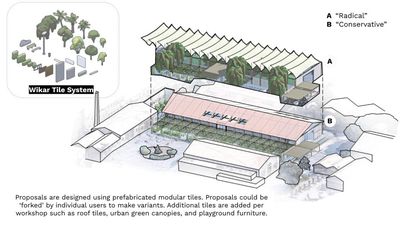
"Scan To Ar": Palermo
A co-design workshop using rapid 3D site capture and an AR design tool with a library of design primitives (akin to Lego bricks). The goal was to repurpose abandoned industrial heritage in Palermo. I collaborated with Federico La Russa to facilitate the workshop, using Wikar (my augmented reality platform) to swiftly mock up and review architectural proposals with stakeholders over a single weekend. The co-design process helped the local campus community collect a public voice for preserving the open space, and the site opened as a public space in October 2022. Conference presentation and publication documented the methodology.
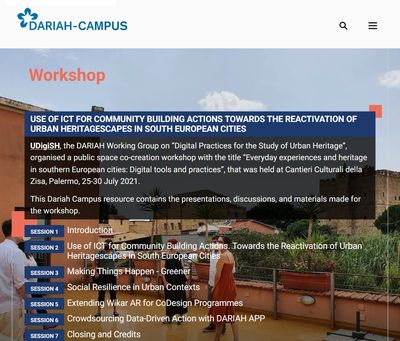
ICT For Urban Heritage: Palermo
A co-design workshop in Palermo to envision the future of an abandoned warehouse, serving as the first field test for my dissertation research on propositional modeling. I designed two competing architectural proposals (conservative and radical) and used my AR platform, Wikar, to allow local stakeholders to view them on-site. By testing the proposals at different scales (a 1:500 map vs. 1:1 walkthroughs), the process surfaced the community's deep attachment to the site's recent, unwritten history as a local park. This visualization work gave their tacit knowledge an empirical basis, and the feedback directly informed the final design, which preserved the area as a public plaza.
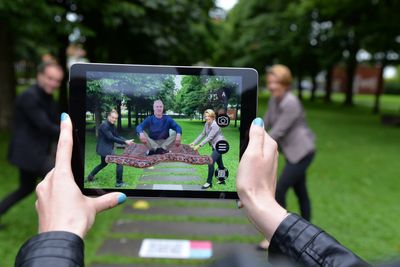
Erwin Wurm
An AR deployment of Erwin Wurm's sculptural works in new contexts using augmented reality. I worked with Studio Calas in an educational and technical capacity, training their team on how to prepare and optimize 3D models for the Wikar platform and its upload pipeline while they handled photogrammetry and content creation. At their request, I also made Wikar's QR code scanning more robust for outdoor environments and for use with different colored tags.
CryoLumens
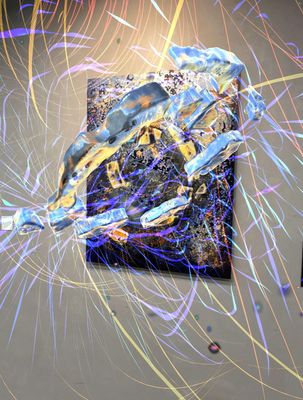
An AR artwork representing the strength and location of Earth's magnetic fields using NASA's real-time sensor network, overlaying data-driven particle systems on an original painting using image tracking. When viewed through a phone, the painting comes alive with particles that shift and flow based on live magnetic field data. I developed the coding and visuals for Eli Joteva.Technical: Live sensor intensities are baked into packed textures so particles animate by interpolating a texture index on the GPU, keeping the visualization real-time without CPU overhead.
Guccibytes
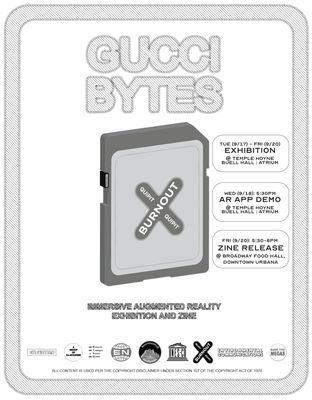
An exhibition and print zine showcasing unfinished speculative pieces from our studio organization, Quipit, with a focus on revealing the often-unseen digital components of our work. The zine was printed on long scrolls wrapped around PVC lattices, with embedded QR codes linking to AR content in Wikar. Each contributor used the platform differently: some created virtual galleries, others showed complex models on virtual plinths, and I created a "3D portal" to show one of my miniature models staged in its fictional setting. The physical exhibition components were built from materials recycled from a previous project.
Timeline Atlas
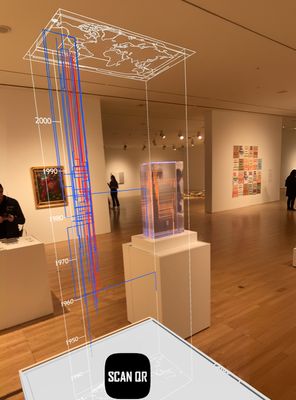
Two AR data-visualization sculptures visualizing datasets too complex to depict through physical sculpture: the home locations of all female senators over the past century. I collaborated with artist Stephen Cartwright, known for meticulously logging personal data over decades and crafting it into acrylic sculptures that exhibit spatial-temporal patterns. We used AR to go beyond his traditional manufacturing techniques. Debuted as part of a faculty showcase in 2019.
Wikar V1
The initial prototype for Wikar, an AR app I designed for viewing cloud-hosted media like artworks and design proposals. During an affiliation with the National Center for Supercomputing Applications' (NCSA) Advanced Visualization Laboratory, I developed this first version to use NCSA's Clowder data repository for storing and distributing Unity asset bundles. The system uses QR codes for URL lookup and precise positioning, enabling multi-user, location-integrated experiences. The project, which received financial support from eDream and the Fiddler Foundation, has since been used by international artists, researchers, architects, and students.
The Austere
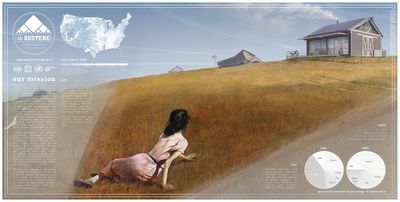
CRITICAL MASS Student Choice Award, 2018A speculative project that imagines a near-future of climate catastrophe where corporations provide prefabricated housing tied to labor contracts. Originally a design-build proposal for the U.S. Solar Decathlon, I reformulated the work to explore how speculative design could feel more imminent and unsettling. Instead of distant hyperbole, the project grounded its extreme scenario in plausible economic and social trends, positioning it between architectural proposal, narrative fiction, and propaganda artifact. Exhibited as a large-format presentation board and later as an augmented reality installation, the work won the Student Choice Award at Critical Mass in 2018.