Engagement: analytics
I research how playable software can produce new knowledge between scholars, institutions, and communities. Game design is a growing practice in academia and meets growing games literacy in the public, but we lack methodologies that operationalize making and play as collaborative humanistic inquiry. My dissertation contributes propositional modeling, a methodology where digital artifacts trigger divergent interpretation and accumulate what that interpretation yields, so that public play compounds knowledge scholars can’t produce alone.
About
I research how playable software can produce new knowledge between scholars, institutions, and communities. Game design is a growing practice in academia and meets growing games literacy in the public, but we lack methodologies that operationalize making and play as collaborative humanistic inquiry. My dissertation contributes propositional modeling, a methodology where digital artifacts trigger divergent interpretation and accumulate what that interpretation yields, so that public play compounds knowledge scholars can’t produce alone.
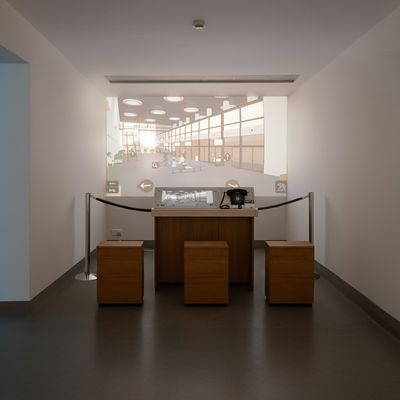
Nicosia International Airport VE
A museum installation featuring a reconstructed 3D model of Nicosia International Airport's modern terminal based on LiDAR scans and archival documentation, housed in a custom-designed wooden console with touchscreen navigation and immersive projection. I developed the participatory virtual environment to test dissertation methodologies on co-constructive virtual places for heritage, featuring a "propositional model" for directing public knowledge toward architectural features, and a period landline phone interface for oral story contribution. I also designed and developed the companion website at velab.cloud/nic/en. Deployed in a public exhibition at the Bank of Cyprus Cultural Foundation, the project captured over 3,200 play sessions and 300 oral story recordings, generating new qualitative data that expands and challenges the site's limited documentation. See the development timeline for in-progress screenshots and photos.
The People's Sky 2
The fifth iteration of the People's Tree series—where players design items and place them in a shared digital space—developed as the centerpiece for the 2025 Madvent launcher. I was invited by the junior team—who had taken over the launcher technology and coordination—to contribute this game for continuity with the series. My contributions focused on technical refinement: redesigning and optimizing the input system for better panning and zooming, recoloring and reskinning the visual aesthetic, and optimizing data serialization and loading sequences. The project marks my transition from lead developer to technical consultant as the junior team took over coordination.
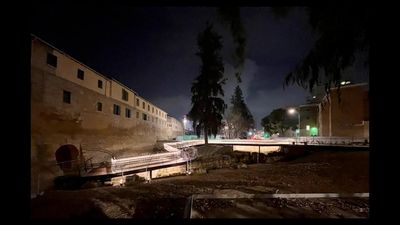
Paphos Gate: Nicosia
Multiple VR applications (using Oculus DK2 and HTC Vive) to visualize archaeological findings and a proposed architectural intervention for an urban archaeology project in Nicosia. I prototyped and built the applications as a research assistant, developing systems for locomotion, interaction, and gaze-tracking analytics to understand how stakeholders focused on the virtual site. These tools engaged everyone from the public to the Department of Antiquities. The gaze-tracking data directly informed the design of the final public walkway and was integrated into the permanent VR exhibit at the museum. The project spanned a decade before the site and its permanent VR exhibit opened to the public in 2024.
The People's Sky
The fourth iteration of the People's Tree series, The People's Sky is an experimental game where players design items, append messages, and place them in a shared digital sky. A key design change was constraining the color palette to reduce the visual cacophony of earlier iterations. I also developed data-transfer optimizations, analytic logs for post-experiment analysis, a web application for content moderation, and 'trace' visualizations that passively record and display player exploration paths.
Córdoba Court
Córdoba Court is a social game I designed and developed as the third iteration of the People's Tree series, modeled after the communal patios of Córdoba, Spain. Players cultivate a shared virtual environment by designing personalized totems from a combinatorial system of parts. The project was released simultaneously through the Haunted PS1 community and as part of the DARIAH Udigish Working Group's survey on Córdoba's communal patios, serving as a social experiment in shared digital space and community greening. A report is also available, which analyzes player content and observed behaviors.
The People's Tree 2
The second iteration of the People's Tree project, an experimental game where participants design ornaments and leave messages on a communal tree in a shared digital space. For this iteration, I rebuilt the underlying technology, expanded content moderation policies, and added more detailed analytics on player behavior.
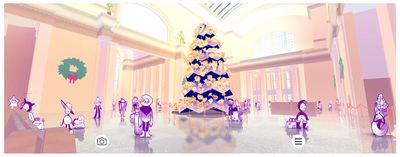
Where's Home?
An experimental game prototype conceived as the next evolution of the People's Tree series. Where previous iterations had players designing ornaments for a shared space, this version reimagined the format around NPCs: players meet characters throughout an abstracted version of Union Station in Chicago, ask them questions, and contribute answers that populate other players' encounters—so the station gradually fills with player-authored characters to discover. The game translated the unshaded, minimalist aesthetic of Rococo into a more detailed architectural style. For the prototype, I developed a custom Rhinoceros plugin to export modular architectural elements, and a separate system to place around 100 unique characters throughout the scene. The project was shelved to allow for more design iteration on its dialogue system.
Minotaur
Minotaur is a digital marble maze inspired by the classic BRIO Labyrinth board game, where players tilt a board to navigate a ball around holes. It also served as my earliest experiment with embedded analytics—I built a system that records play sessions and sends summary data to a Clowder data repository. This work enabled long-term data collection, and the results from over three years and thousands of play sessions are analyzed in this report.
The People's Tree
The People's Tree was the first in a series of experimental games I created to explore community building in networked spaces. In this project, players design ornaments and leave messages on a shared tree. It was my first opportunity to build the underlying technology, develop content policies, and run analytics for a live, public-facing application. A key finding from this and subsequent projects was an unexpectedly high player return rate of 15-30%, suggesting that players felt a personal stake in the collectively-designed artifact and returned to observe its evolution.