Engagement: citizen-science
I research how playable software can produce new knowledge between scholars, institutions, and communities. Game design is a growing practice in academia and meets growing games literacy in the public, but we lack methodologies that operationalize making and play as collaborative humanistic inquiry. My dissertation contributes propositional modeling, a methodology where digital artifacts trigger divergent interpretation and accumulate what that interpretation yields, so that public play compounds knowledge scholars can’t produce alone.
About
I research how playable software can produce new knowledge between scholars, institutions, and communities. Game design is a growing practice in academia and meets growing games literacy in the public, but we lack methodologies that operationalize making and play as collaborative humanistic inquiry. My dissertation contributes propositional modeling, a methodology where digital artifacts trigger divergent interpretation and accumulate what that interpretation yields, so that public play compounds knowledge scholars can’t produce alone.
The People's Sky 2
The fifth iteration of the People's Tree series—where players design items and place them in a shared digital space—developed as the centerpiece for the 2025 Madvent launcher. I was invited by the junior team—who had taken over the launcher technology and coordination—to contribute this game for continuity with the series. My contributions focused on technical refinement: redesigning and optimizing the input system for better panning and zooming, recoloring and reskinning the visual aesthetic, and optimizing data serialization and loading sequences. The project marks my transition from lead developer to technical consultant as the junior team took over coordination.
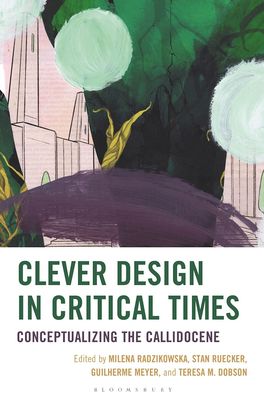
Are Surveys Necessary? Designing Virtual Environments for Participatory Research
A prototype Virtual Environment (VE) designed as an immersive online 'guest book' where hundreds of users could asynchronously decorate a shared virtual space and leave messages for one another. I developed this VE for a workshop on the intangible cultural heritage of Córdoba's communal patios, introducing key design strategies for asynchronous interaction ('claims' and 'traces') and a novel workflow using Large Language Models (LLMs) to automate qualitative coding and moderation of text contributions. Published as a book chapter in the 2025 Bloomsbury Academic volume, Clever Design in Critical Times: Conceptualizing the Callidocene, arguing that interactive VEs can serve as effective tools for participatory research beyond traditional surveys in the Digital Humanities. The book is available from Bloomsbury Academic.
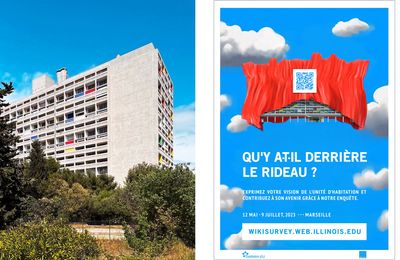
Unité d'Habitation Wikisurvey
A wiki survey tool—a survey format where participants both vote on and submit new options, so the survey evolves as people interact with it. This implementation draws on two prior systems (All Our Ideas and POLIS) and adds AI-assisted seed generation and automated qualitative coding. I developed this web application as part of the MetaFraming research.
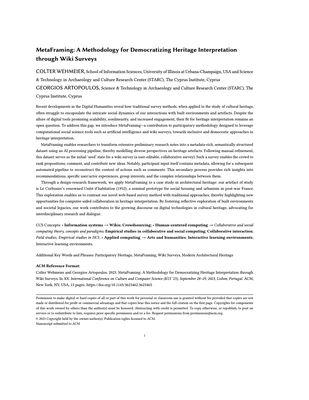
MetaFraming: A Methodology for Democratizing Heritage Interpretation through Wiki Surveys
A participatory methodology for heritage study using AI-assisted wiki surveys, a technology from the computational social sciences that allows the survey itself to evolve as people interact with it. I developed MetaFraming using three distinct GPT-3.5 pipelines: one generates hundreds of 'seed' propositions from background research (controlled for tone and topic), another interprets user-submitted comments by providing contextual history of their interactions, and a third automatically codes comments for sentiment and topics to speed qualitative analysis and aid abuse detection. The methodology was developed through a case study on Le Corbusier's Unité d'habitation and published as a conference paper. Read the full paper here.
The People's Sky
The fourth iteration of the People's Tree series, The People's Sky is an experimental game where players design items, append messages, and place them in a shared digital sky. A key design change was constraining the color palette to reduce the visual cacophony of earlier iterations. I also developed data-transfer optimizations, analytic logs for post-experiment analysis, a web application for content moderation, and 'trace' visualizations that passively record and display player exploration paths.
Córdoba Court
Córdoba Court is a social game I designed and developed as the third iteration of the People's Tree series, modeled after the communal patios of Córdoba, Spain. Players cultivate a shared virtual environment by designing personalized totems from a combinatorial system of parts. The project was released simultaneously through the Haunted PS1 community and as part of the DARIAH Udigish Working Group's survey on Córdoba's communal patios, serving as a social experiment in shared digital space and community greening. A report is also available, which analyzes player content and observed behaviors.
The People's Tree 2
The second iteration of the People's Tree project, an experimental game where participants design ornaments and leave messages on a communal tree in a shared digital space. For this iteration, I rebuilt the underlying technology, expanded content moderation policies, and added more detailed analytics on player behavior.
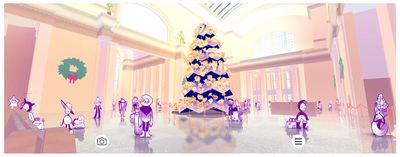
Where's Home?
An experimental game prototype conceived as the next evolution of the People's Tree series. Where previous iterations had players designing ornaments for a shared space, this version reimagined the format around NPCs: players meet characters throughout an abstracted version of Union Station in Chicago, ask them questions, and contribute answers that populate other players' encounters—so the station gradually fills with player-authored characters to discover. The game translated the unshaded, minimalist aesthetic of Rococo into a more detailed architectural style. For the prototype, I developed a custom Rhinoceros plugin to export modular architectural elements, and a separate system to place around 100 unique characters throughout the scene. The project was shelved to allow for more design iteration on its dialogue system.
The People's Tree
The People's Tree was the first in a series of experimental games I created to explore community building in networked spaces. In this project, players design ornaments and leave messages on a shared tree. It was my first opportunity to build the underlying technology, develop content policies, and run analytics for a live, public-facing application. A key finding from this and subsequent projects was an unexpectedly high player return rate of 15-30%, suggesting that players felt a personal stake in the collectively-designed artifact and returned to observe its evolution.